Addiction runs through families due to a combination of genetics, learned behaviors, shared environments, and emotional patterns passed from one generation to the next. At Southeastern Recovery Center, we help individuals understand that family history can increase risk, but it does not determine destiny. With awareness, support, and treatment, cycles of addiction can be interrupted and healing can begin.
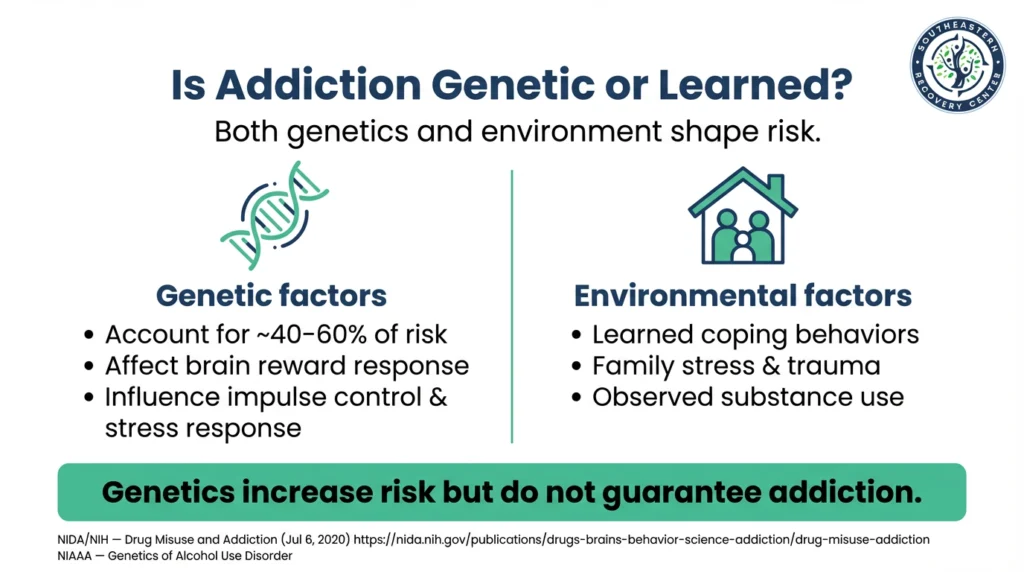
Addiction is influenced by both genetics and environment.
Research shows:
This combination explains why addiction often appears across generations.
Some people inherit a higher biological vulnerability to addiction.
Genetic factors may affect:
Genetics increase risk, but they do not guarantee addiction.
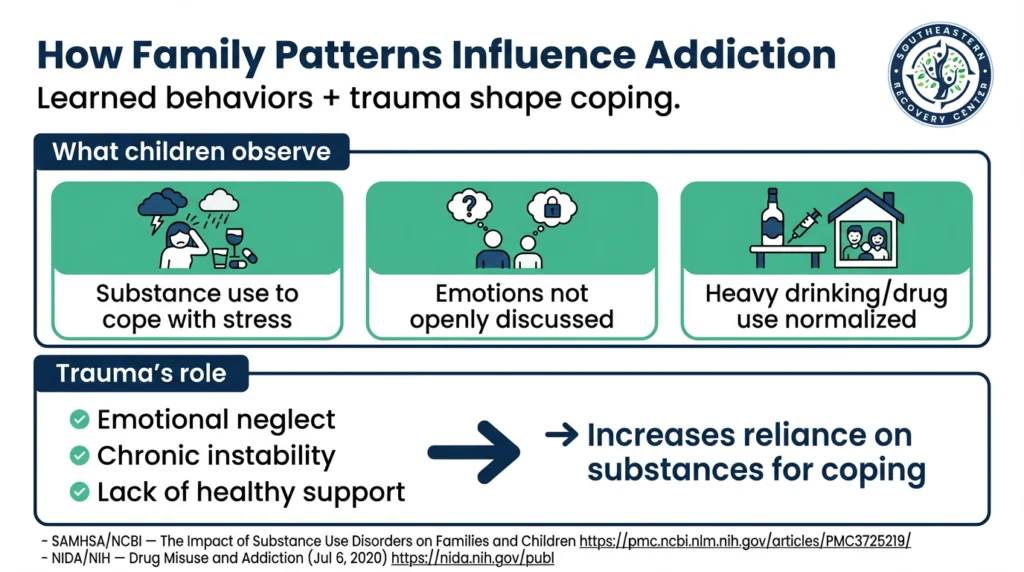
Children often learn coping strategies by observing caregivers.
In families affected by addiction, children may learn to:
These learned behaviors can continue into adulthood.
Trauma is a powerful contributor to addiction.
Family-related trauma may include:
Unresolved trauma increases the likelihood of substance use as a coping mechanism.
Yes. Addiction often reshapes family dynamics.
Common patterns include:
These patterns can persist even after substance use stops unless addressed.
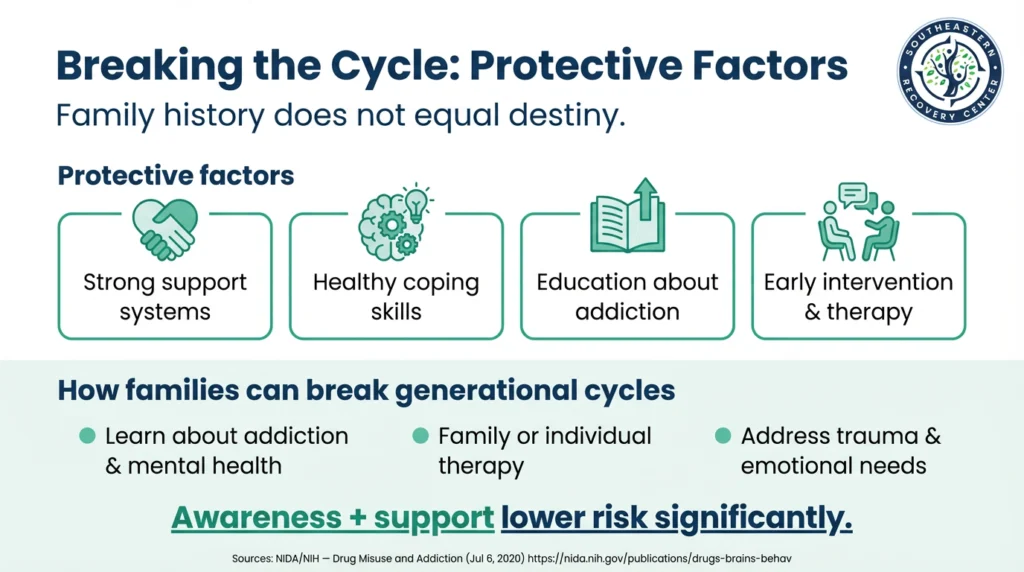
No. Many people from families affected by addiction never develop substance use disorders.
Protective factors include:
Awareness significantly lowers risk.
Breaking generational cycles requires intentional support.
Helpful steps include:
At Southeastern Recovery Center, family involvement is often a key part of healing.
At Southeastern Recovery Center, we treat addiction as a family-affected condition.
Support may include:
Healing the family system strengthens recovery outcomes.
Addiction may run through families, but so can resilience, growth, and recovery. Understanding the patterns that contribute to substance use empowers individuals to make different choices.
At Southeastern Recovery Center, we believe that breaking generational cycles is possible with support, education, and compassionate care.
Centers for Disease Control and Prevention. Genetics and Health.
CDC, www.cdc.gov/genomics/famhistory.
Harvard Health Publishing. The Genetics of Addiction.
Harvard Medical School, www.health.harvard.edu/blog/the-genetics-of-addiction-2019012515730.
Mayo Clinic. Addiction: Family Risk Factors.
Mayo Foundation for Medical Education and Research, www.mayoclinic.org/diseases-conditions/drug-addiction/in-depth/risk-factors.
National Institute on Drug Abuse. Genetics and Epigenetics of Addiction.
National Institutes of Health, www.nida.nih.gov/research-topics/genetics-epigenetics.
Substance Abuse and Mental Health Services Administration. Family Therapy Can Help.
U.S. Department of Health and Human Services, www.samhsa.gov/find-help/family.