Alcoholism is considered a chronic disease that also involves mental health components, rather than being solely a mental illness. At Southeastern Recovery Center, we help individuals understand that alcohol use disorder affects both the brain and behavior, which is why treatment must address physical, psychological, and emotional factors together. Viewing alcoholism as a disease reduces stigma and encourages people to seek appropriate care.

Alcoholism is clinically referred to as alcohol use disorder.
Medical professionals define it as:
It exists on a spectrum from mild to severe.
Alcoholism is clinically referred to as alcohol use disorder.
Medical professionals define it as:
It exists on a spectrum from mild to severe.
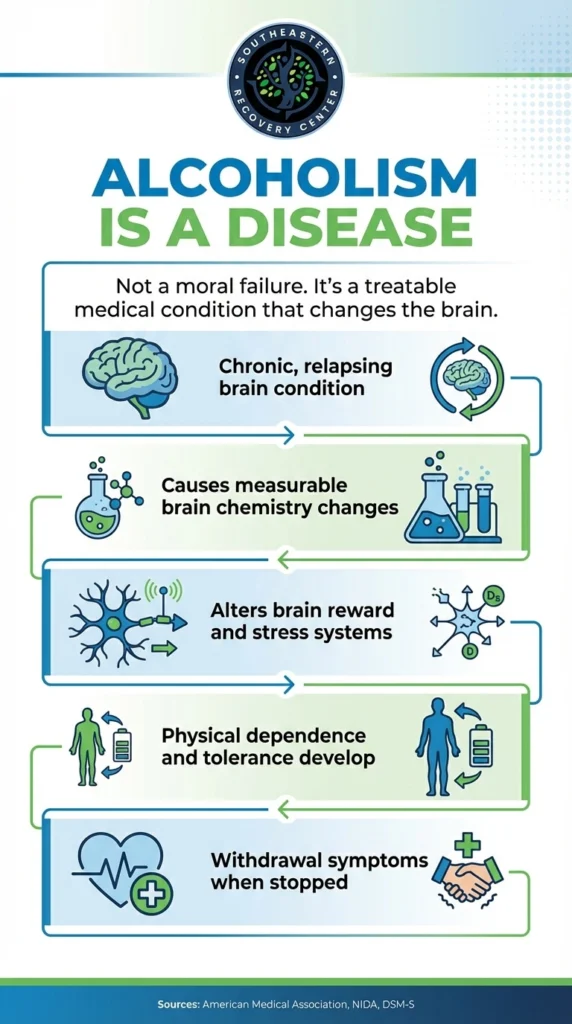
Alcoholism is classified as a disease because it causes measurable changes in the brain and body.
These changes include:
Like other chronic diseases, it often requires ongoing management.
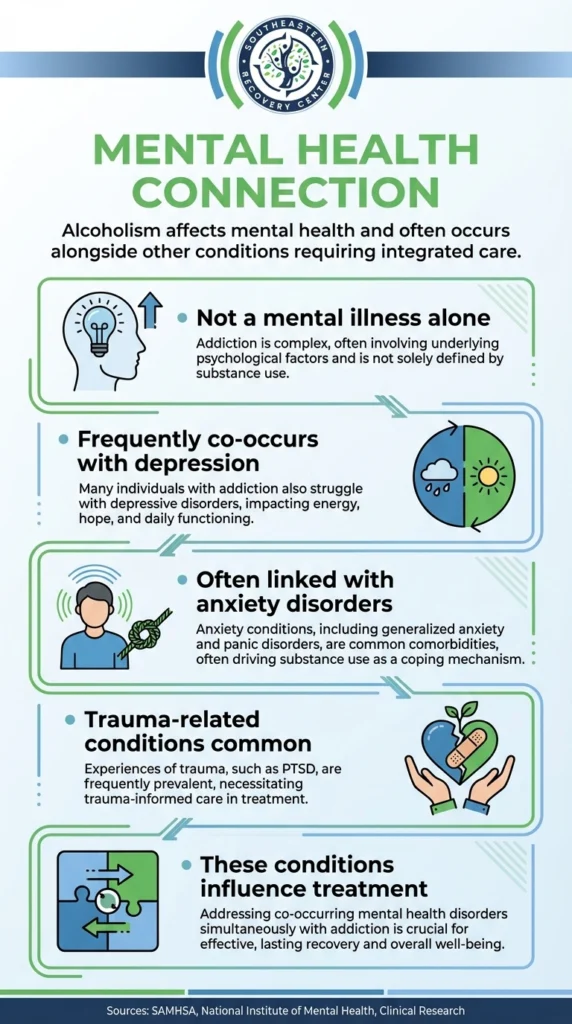
Alcoholism is not classified as a mental illness on its own, but it strongly affects mental health.
Alcohol use disorder frequently occurs alongside:
These co-occurring conditions influence how addiction develops and how it is treated.
Brain imaging and research show that alcohol changes how the brain functions.
Effects include:
These changes explain why willpower alone is often not enough.
Understanding alcoholism as a disease changes how people approach recovery.
It:
This approach leads to better outcomes.
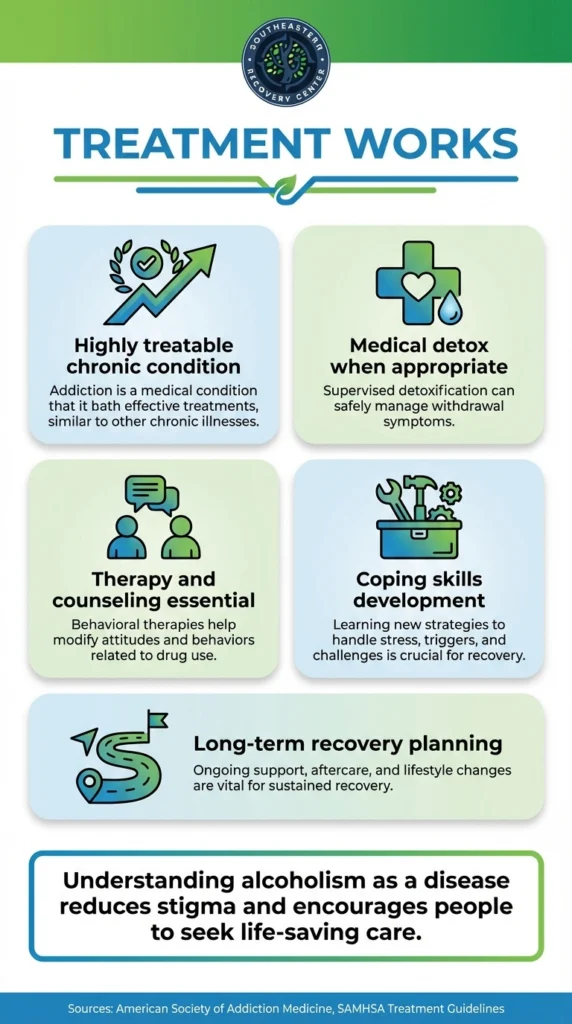
Yes. While alcoholism is chronic, it is highly treatable.
Effective treatment often includes:
Many people achieve lasting recovery with support.
At Southeastern Recovery Center, treatment is compassionate and evidence-based.
Our approach includes:
We focus on healing the whole person.
Alcoholism is not a moral failure or lack of discipline. It is a disease that affects the brain, behavior, and health. At Southeastern Recovery Center, we believe that understanding alcoholism through a medical and compassionate lens helps people access care, rebuild confidence, and move toward lasting recovery.
Sources
American Medical Association. Alcoholism.
American Medical Association, www.ama-assn.org.
Mayo Clinic. Alcohol Use Disorder.
Mayo Foundation for Medical Education and Research, www.mayoclinic.org/diseases-conditions/alcohol-use-disorder.
National Institute on Alcohol Abuse and Alcoholism. Understanding Alcohol Use Disorder.
National Institutes of Health, www.niaaa.nih.gov/health-professionals-communities/alcohol-use-disorder.
National Institute on Drug Abuse. The Science of Addiction.
National Institutes of Health, www.nida.nih.gov/research-topics/addiction-science.
Substance Abuse and Mental Health Services Administration. Substance Use Disorders.
U.S. Department of Health and Human Services, www.samhsa.gov/find-help/disorders.