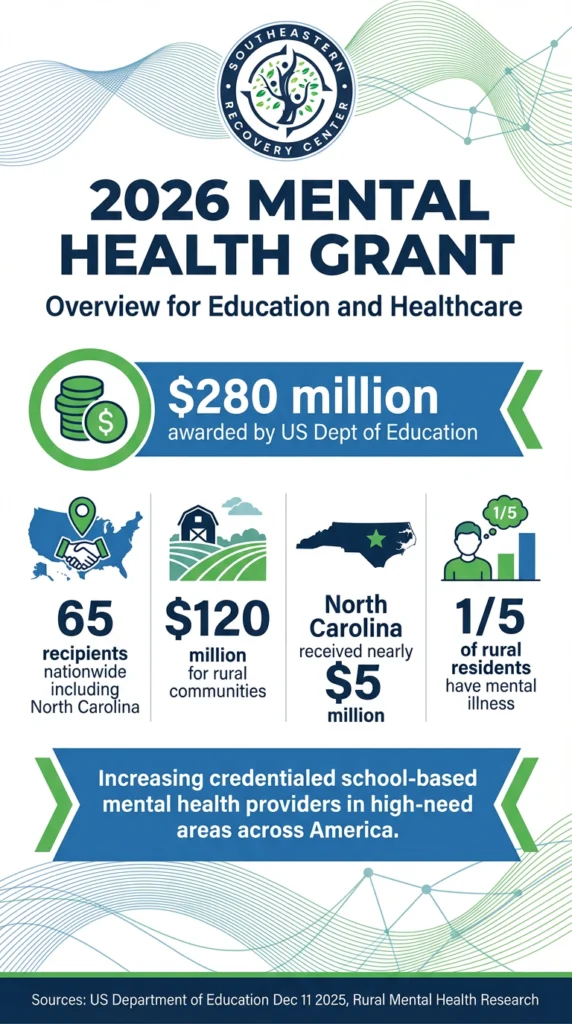
On December 11, 2025, the US Department of Education announced over $280 million in new grant awards for the mental health service professional demonstration and school-based mental health programs.
As U.S. Secretary of Education Linda McMahon states, “Today, over $200 million is being awarded directly to states and school districts to support student mental health – a meaningful win for our education system.”
Thankfully, North Carolina is one of the designated 65 recipients that will be receiving this grant. The only question remains, how is this grant meant to be used, and how is it likely to impact North Carolinians looking for expanded access to mental health resources?
Article Preview:
The 2026 Mental Health Grant. The US Department of Education awarded more than $280 million dollars towards mental health.
How Does the 2026 Mental Health Grant Help North Carolina? North Carolina was one of the states that directly received money from this grant.
The Project AWARE Impact and Implications. While collaboration has not yet been announced, Project AWARE’s mission to to increase access to mental health services overlaps with the 2026 mental health grants goal of increasing mental health access in rural areas
The Future of Mental Healthcare Access in North Carolina. Initiatives like the grant and Project AWARE making it easier for North Carolinians to get mental health care from qualified teachers.
Frequently Asked Questions about Project AWARE & The 2026 Mental Health Grants: What’s in it for Teachers? Learn frequently asked questions about the 2026 mental health grants and Project AWARE.
The 2026 Mental Health Grant
As outlined in the press release that came from the US Department of Education, these awards are designed to increase the number of credentialed school-based mental health service providers, delivering mental health services to students in high need local educational agencies. The Trump administration argues that prior to their restructuring of how to award grants, the Biden administration prioritized ideology and other priorities out of line with the Trump administration.
Of the 65 new awards, 33 are stated to serve rural communities with an allocation of more than 120 million towards these rules states and school districts. This is a particularly good move, because historically rural communities suffer from mental health disparities.
As a 2020 study notes, despite 1/5 of the US population living in a rural area, and about 1/5 of those living in a rural area (6.5 million individuals) having a mental illness, adults residing in rural geographic locations receive mental health treatment less frequently and often with providers with less specialized training.
This means that both access to and quality of mental health resources are likely to pale in rural communities compared to their more urban counterparts. At Southeastern Recovery Center, we’ve witnessed ourselves how much of a difference being able to provide personalized, high-quality mental health care makes for individuals that suffer from mental health disorders such as anxiety, PTSD, and depression. Individuals in rural communities not only deserve but need to be able to get in contact with properly trained medical professionals as conveniently as possible.
The press release from the Department of Education goes on to outline four specific goals it means for this money to support:
- Enhance rural and high-need area capacity to deliver evidence-based interventions;
- Lower student-to-school psychologist ratios;
- Support provider recruitment and retainment through bonuses, stipends, and community support; and
- Strengthen and sustain the school-based mental health workforce.
How Does the 2026 Mental Health Grant Help North Carolina?
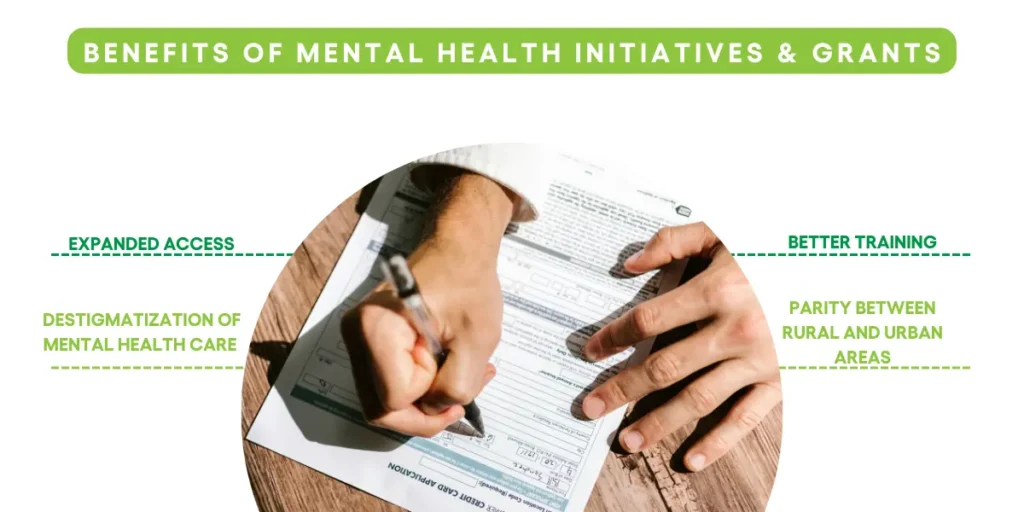
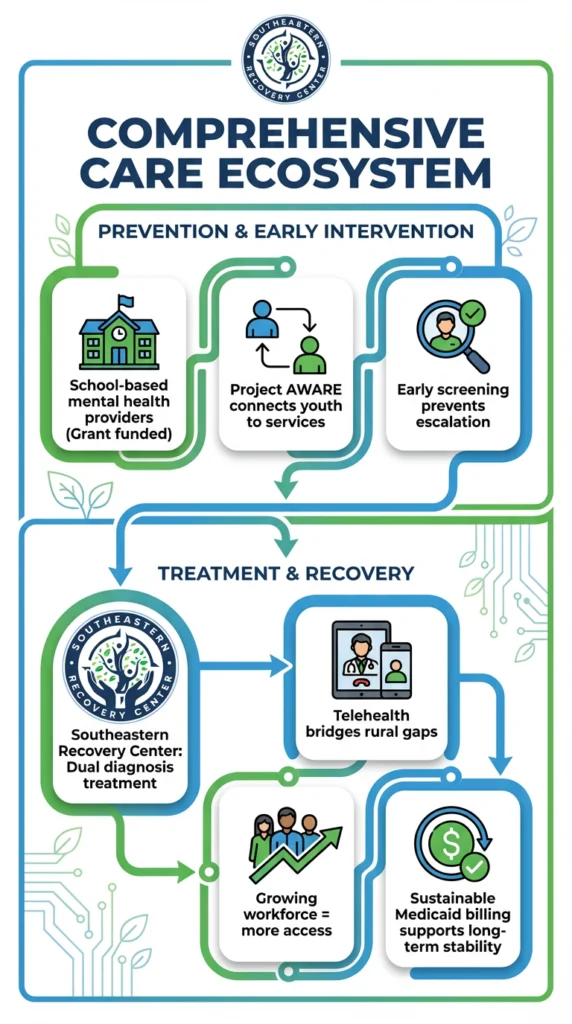
A look at the grant itself outlines almost $5 million allocated towards the North Carolina Department of Public Instruction. As described, they mean to improve access to mental health services by deploying a licensed school psychologist and clinicians, building university partnerships, creating a “grow your own” training pipeline, developing long-term sustainability through Medicaid billing systems, and providing outreach and telehealth access, among other things.
The scope of these initiatives is great for improving rural access to mental health care both in the short-term and long-term. In particular, the “grow-your-own” training pipeline will help ensure that new generations of mental health professionals are continuing to take up the cause of championing improved mental health in North Carolina.
Because the money is being funneled directly into the NC Department of Public instruction, there is also a chance that some of the money makes its way into North Carolina’s Project AWARE.
The Project AWARE Impact and Implications
Project AWARE (which stands for Advancing Wellness and Resiliency in Education) is a collaboration between the North Carolina Department of Public Instruction and the North Carolina Department of Health and Human Services. The goal of this initiative is to develop a “comprehensive plan of activities, services, strategies for connecting youth and families to mental health services and three pilot school districts.”
Project AWARE, which is sometimes known locally as NC Project ACTIVATE (Advancing Coordinated and Timely InterVentions, Awareness, Training, and Education), also seeks to improve access to mental health care resources. Project AWARE/ACTIVATE has a particular focus on NC students in grades PK-12 and is typically awarded funding by the Substance Abuse and Mental Health Services Administration (SAMHSA).
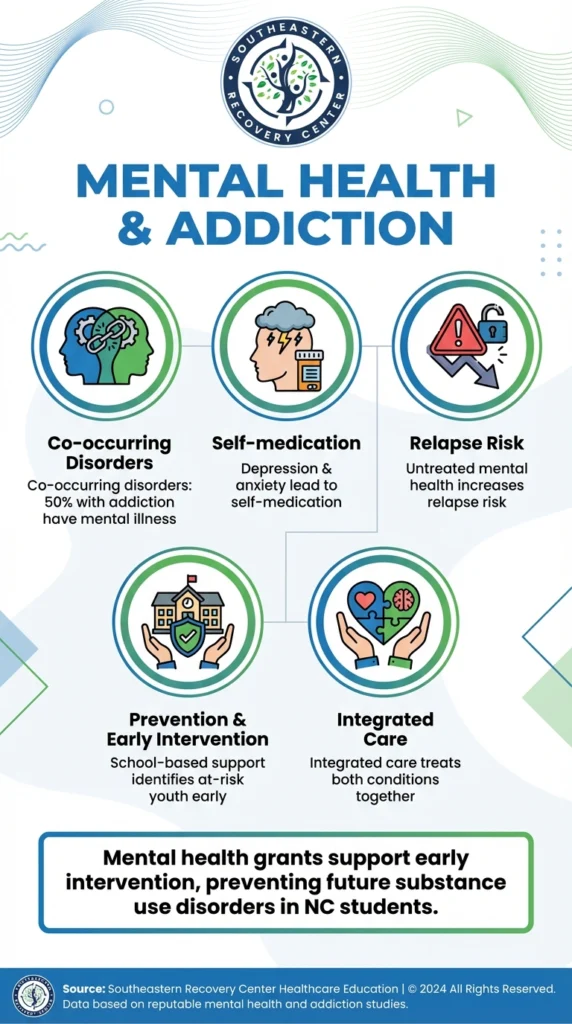
As of yet, no announcements have been made as to whether the 2026 Mental Health Grant for North Carolina will result in additional funding for Project AWARE. However, considering that 23% of children aged 3 to 17 are found to have been diagnosed with anxiety, behavior disorders, or depression, it would make sense for Project AWARE and the North Carolina Department of Public Instruction to collaborate on making sure North Carolina’s adolescents have access to proper mental health care.
The Future of Mental Healthcare Access in North Carolina
Initiatives like the 2026 Mental Health Grants and Project AWARE are necessary steps to help improve access to mental health care for children and inhabitants in rural areas. The more funding and resources provided to facilities, psychiatrists, and teachers, the more individuals will be able to receive high quality care for their mental health disorders. Additionally, big press releases also help spread awareness for the fact that access to rural mental healthcare is an issue at all.
Just signal boosting the problem can be useful to recruit individuals who are able to provide aid either through donations or from volunteering in the capacity as teachers or mental health professionals. In the end, America continues to work towards parity when it comes to mental health care access in both rural and urban areas.
Frequently Asked Questions about Project AWARE & The 2026 Mental Health Grants: What’s in it for Teachers?
What is Project AWARE?
Project AWARE is an initiative between the North Carolina Department of Public Instruction and the North Carolina Department of Health and Human Services to provide more access to mental health services for youth and families.
What does Project AWARE stand for?
Project AWARE stands for Advancing Wellness and Resiliency in Education.
How much money did the US Department of Education announce in mental health grants?
The US Department of Education announced $280 million in new grant awards for mental health.
Who funds Project AWARE?
Project AWARE is typically funded by the Substance Abuse and Mental Health Services Administration (SAMHSA).
Sources:
“U.S. Department of Education Awards over $208 Million in Mental Health Grants.” U.S. Department of Education, 11 Dec. 2025, www.ed.gov/about/news/press-release/us-department-of-education-awards-over-208-million-mental-health-grants.
Morales, Dawn A., et al. “A Call to Action to Address Rural Mental Health Disparities.” Journal of Clinical and Translational Science, vol. 4, no. 5, 2020, pp. 1–20. National Library of Medicine, www.ncbi.nlm.nih.gov/pmc/articles/PMC7681156/, https://doi.org/10.1017/cts.2020.42.
“NC Project AWARE/ACTIVATE | NC DPI.” Nc.gov, 2018, www.dpi.nc.gov/districts-schools/classroom-resources/office-teaching-and-learning/programs-and-initiatives/nc-healthy-schools/nc-project-awareactivate.