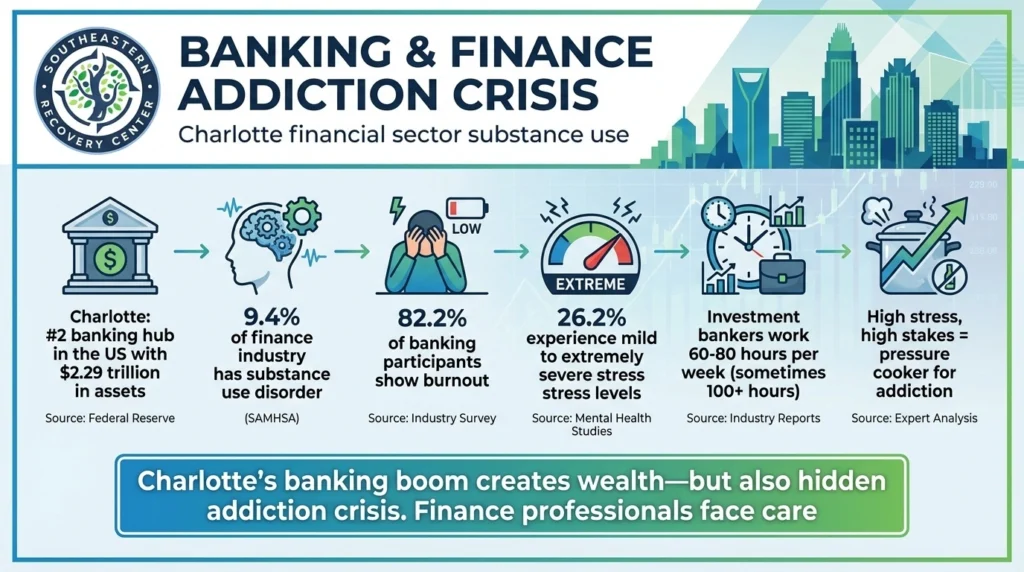
High stress and high-stakes jobs like banking and finance are pressure cookers for the type of mental strain that can lead individuals towards addiction. Charlotte, North Carolina, is the number two banking hub in the United States, with our banks having $2.29 trillion in assets. The desire to keep up high performance, or the need to cope with the stress of such an expectation, can lead to bankers turning to drugs to self-medicate, as is the case with those who end up in executive drug rehab in Charlotte.
What’s worse, is that if individuals realize the mistake they’ve made turning to drugs, they may struggle with the idea of seeking help. A finance professional risks career-ending consequences if they’re discovered to have been on drugs while on the job.
Finance professional addiction help in NC requires discretion and know-how on how to deliver executive drug rehab in Charlotte and other areas around North Carolina. And while we at Southeastern Recovery Center can deliver on this need, this post will go into some of the surrounding complications.
Article TL;DR: Banking and finance professionals are drawn to drugs to help cope with stress or to try to maintain high performance around-the-clock. Once individuals fall into the trap of using drugs, they’ll need to find drug addiction treatment that provides a high level of discretion to avoid damage to their careers.
Article Preview:
Why Do Banking and Finance Professionals Do Drugs? Banking and finance professionals do drugs to cope with the high stress, high-stakes job, or to try to maintain high performance.
What Kind of Drugs Do Banking and Financial Professionals Take? Banking and finance professionals take drugs such as alcohol, fentanyl, Adderall, and opioids.
Do Banking Executives Do Drugs, or Just Low Level Bank Employees? All levels of banking employees may do drugs.
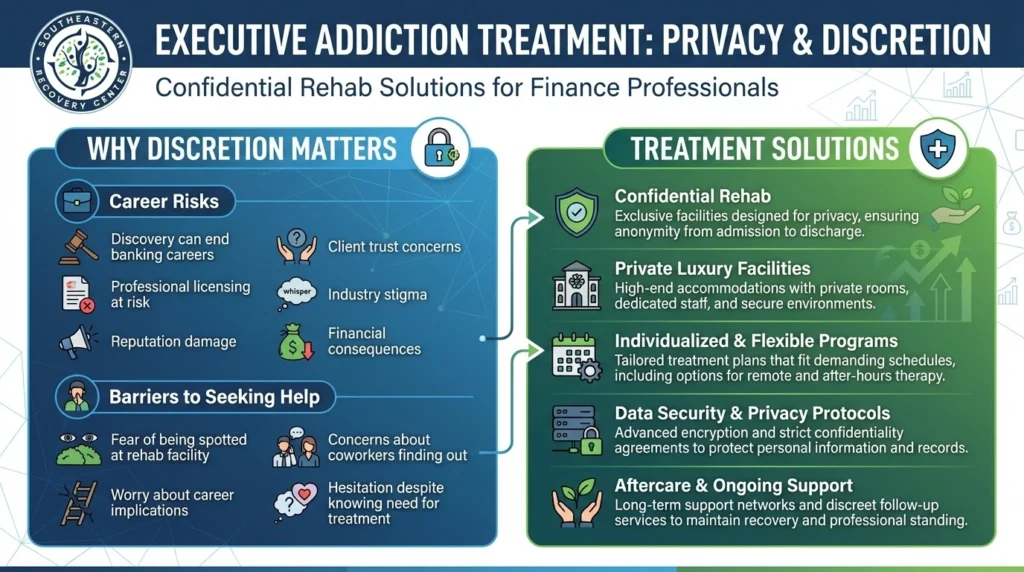
Do Finance Professionals and Bankers Get Different Drug Addiction Treatment Than the General Population? Finance professionals and bankers do not necessarily get a different quality of drug addiction treatment, but they may take extra precaution to ensure that their privacy is maintained.
FAQs about High-Stress, High Stakes: Addiction Treatment for Charlotte’s Banking & Finance Professionals. Get answers to frequently asked questions about drugs in banking and finance.
Why Do Banking and Finance Professionals Do Drugs?
There are a couple of reasons why bankers and finance professionals returned to drug usage. The first primary factor is stress. Banking and finance are high stress, high-stakes jobs. Studies have noted the workload, complex interpersonal relationships, and burnout as the primary catalyst for stress. A 2024 study found that burnout was observed in 82.2% of banking participants, while 26.2% showed “mild to extremely severe” stress levels. These factors could very easily push an individual towards usage of alcohol or drugs such as opioids to self medicate for their stress.
There’s also the flipside to consider: the idea of taking drugs in order to improve performance. Investment bankers are stated to work 60 to 80 hours per week, and occasionally even exceed that to reach over 100 hours a week. The need to deliver high-quality work despite this grueling schedule might push bankers and finance professionals towards stimulants such as Adderall. Unfortunately, these substances have numerous side effects in addition to their addictive qualities.
The Substance Abuse and Mental Health Services Administration (SAMHSA) found that substance use disorder occurred in the finance industry at a rate of 9.4%. With Charlotte being the second-largest banking hub in the United States, it’s no wonder why finance professionals would seek addiction help in NC.
What Kind of Drugs Do Banking and Financial Professionals Take?
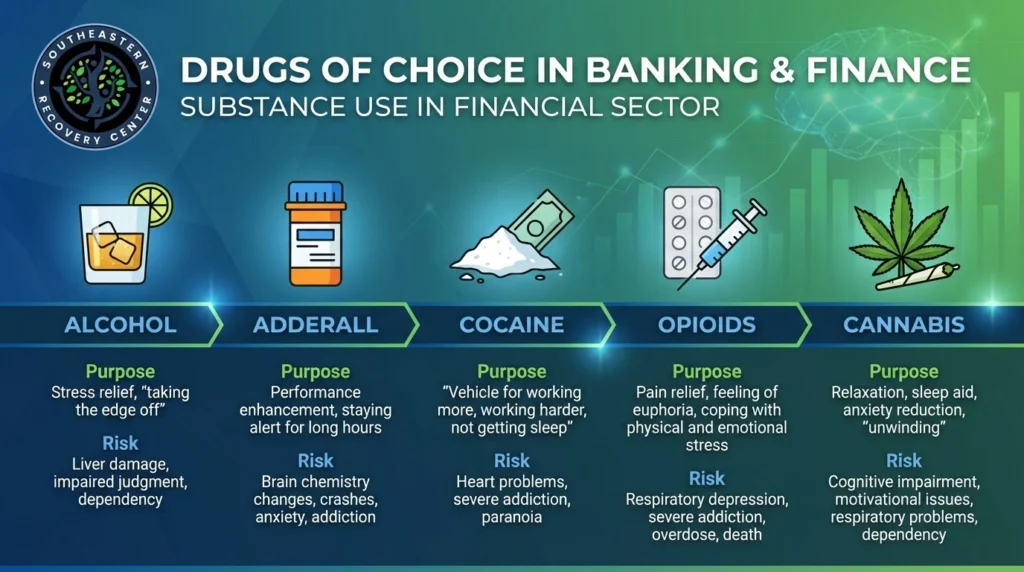
There are several drugs that bankers and finance professionals will partake in, including:
- Alcohol
- Opioids
- Fentanyl
- Adderall
- Cocaine
Usage of these drugs would vary, from stress relief in the case of alcohol and opioids, to abusing stimulants in order to complete work by using Adderall or cocaine. Business Insider interviewed an assortment of bankers and professionals connected to the world of finance who attested to the usage of these drugs. Of cocaine and Adderall, it was believed that these drugs would act as “a vehicle for working more, working harder, not getting sleep, getting more bonuses and more stock options, and being successful.”
Unfortunately, the belief that these drugs can be used strategically is a false one. Using these substances causes shifts in the brain chemistry of your body and brain, which makes your system more dependent on them. This is how dependence and then addiction develop. At that point, ceasing use of these drugs goes beyond a matter of willpower and desire, especially with withdrawal symptoms making it hard to treat addiction at home. This is when it’s important for executives to seek out drug rehab in Charlotte and other areas around North Carolina.
Do Banking Executives Do Drugs, or Just Low-Level Bank Employees?
Banking executives and low-level bank employees are equally likely to do drugs and develop substance use disorders. This is because banking is a demanding job at all levels, which means the stress and desire to perform well around-the-clock exists for all finance employees.
Do Finance Professionals and Bankers Get Different Drug Addiction Treatment Than the General Population?
Finance professionals and bankers will generally receive similar treatment at drug addiction facilities. However, at a facility like Southeastern Recovery Center, this means that each banker will receive personalized treatment that fits their goals, lifestyle, and environment. That means that no two treatment plans will ever look identical.
Additionally, any facility providing professional addiction help for finance professionals and bankers will likely understand ahead of time how important discretion is. Whether these are executives or bank clerks, knowledge of an individual seeking help with their addiction should be kept private. While this is generally the case for all individuals seeking drug addiction treatment, facilities may take extra precautions to assure bankers that their privacy will be protected.
Additionally, bank executives who are wary about being spotted at a drug facility may be able to make use of telehealth in order to receive Virtual IOP (aka drug addiction treatment delivered virtually) from the privacy of their homes.
FAQs about High-Stress, High Stakes: Addiction Treatment for Charlotte’s Banking & Finance Professionals
Why do banking and finance professionals use drugs?
Banking and finance professionals do drugs in order to cope with the stress of their job or to try to guarantee high performance despite working long hours.
Do bank executives need a different type of drug rehab than lower-level employees?
Bank executives do not necessarily need a different type of drug rehab than lower-level employees, but they may want to take advantage of virtual rehab programs in order to receive treatment without being spotted at a rehab facility.
What kind of drugs do bankers and financial professionals take?
Bankers and financial professionals are known to take drugs such as opioids, Adderall, and cocaine.
Is drug usage as high in the finance industry as it used to be?
No, drug usage in the finance industry is generally regarded as being lower than times past.
Sources:
Roberts, Deon. “Charlotte Regains Its Place as No. 2 U.S. Banking Center. Will It Keep It?” Charlotte Observer, 15 Nov. 2018, www.charlotteobserver.com/news/business/banking/article221589840.html.
Vinod, Guruprasad, and Srikant Ambatipudi. “Burnout, Stress, and Their Correlates among Bank Employees of South India: A Cross-Sectional Study.” Ann Occup Environ Med, vol. 36, 28 Aug. 2024, p. e22, https://doi.org/10.35371/aoem.2024.36.e22. Accessed 29 Sept. 2024.
Bush, Donna, and Rachel Lipari. “Substance Use and Substance Use Disorder by Industry.” Samhsa.gov, 16 Apr. 2015, www.samhsa.gov/data/sites/default/files/report_1959/ShortReport-1959.html.
Whitehouse, Alex Nicoll, Dakin Campbell, Alex Morrell, Hayley Cuccinello, Emmalyse Brownstein, Bradley Saacks, Bianca Chan, Kaja. “From Cocaine to Psychedelics, Traders and Bankers Take Us inside Wall Street’s Underground Drug Culture.” Business Insider, www.businessinsider.com/wall-streets-underground-drug-abuse-culture-cocaine-adderall-zyn-mushrooms-2024-1.