What happens when a North Carolina teacher witnesses signs of drug or alcohol addiction in their own classroom? How educators should handle drug addiction in students is rarely addressed, despite the fact that in 2023, 9.2 million people aged 18 to 25 were found to have a substance use disorder (SUD). College-aged students (and in some cases students even younger) are beginning to develop substance use disorders for everything from alcohol to Adderall and even fentanyl.
At the same time, educators are overburdened, dealing with poor wages, high stress, and issues revolving around managing students. To ask NC educators to also be ready and capable to help students overcome drug or alcohol addiction may be one ask too many.
Thankfully, teachers don’t have to tackle student drug addiction on their own. At Southeastern Recovery Center, we provide personalized and specialized recovery resources to all our patients, arming them with the tools they need to overcome substance use disorders. With vigilant teachers able to recognize when a student is struggling with substance abuse, treatment facilities like ours can help handle the actual recovery process.
Article TL;DR: While teachers are not expected to help cure students of addiction, they are expected to notice and report on signs of addiction. However, teachers armed with resources from treatment facilities like Southeastern Recovery Center can take an additional step to connect students with the help they need, without demanding too much of the teacher.
Article Preview:
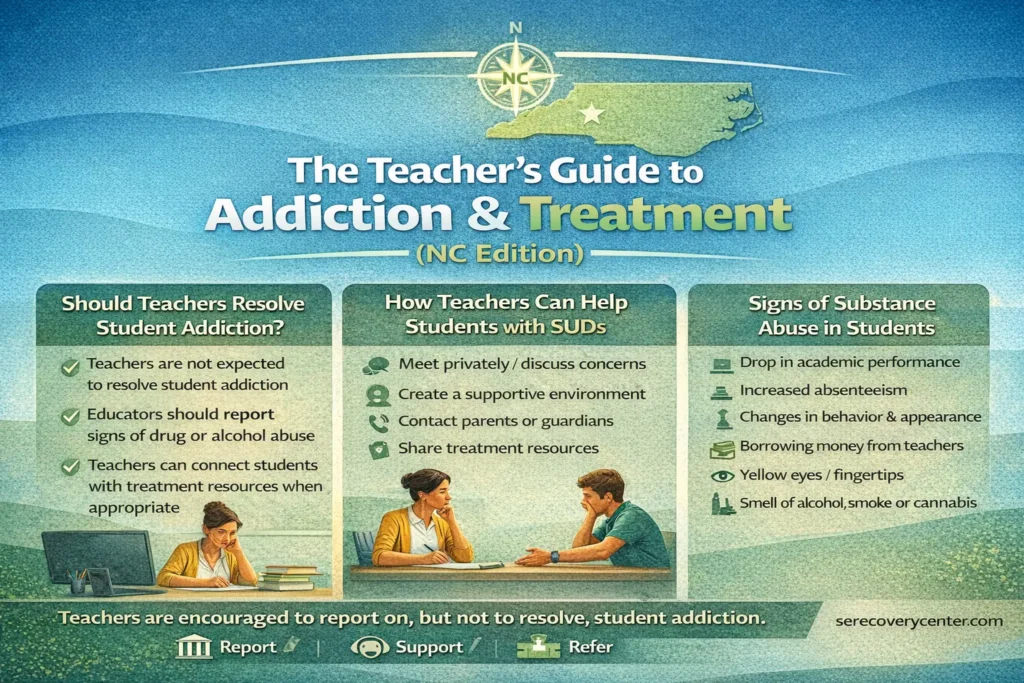
Should Teachers Be Expected to Resolve Drug or Alcohol Addiction in Students? Teachers are not expected to resolve drug or alcohol addiction, but they are expected to report on it if they notice signs of it.
How Can Teachers Help Students Suffering from Substance Use Disorders? Teachers can help students suffer from substance use disorders by reaching out to them and contacting parents and authority figures.
Signs of Substance Abuse in Students for Teachers to Watch Out For. Signs of substance abuse in students include changes in typical classroom behavior, a sudden drop in grades, and students lacking energy or motivation in class.
Common Substances Used by Students. Students abuse substances like alcohol, Adderall, and opioids.
What Happens if a Teacher Doesn’t Address a Student’s Addiction Problem? If a teacher doesn’t address a student’s addiction problem, there is a chance that the student may fall further into addiction and end up expelled.
FAQs about The Teacher’s Guide to Addiction & Treatment (NC Edition). Learn answers to frequently asked questions about teachers dealing with student addiction and treatment.
Should Teachers Be Expected to Resolve Drug or Alcohol Addiction in Students?
One thing needs to be made clear: as is, educators in Mecklenburg County and across North Carolina at large have a lot to handle. Teachers have to juggle standard behavioral issues with students, workloads that follow them home, burnout, and low wages. As a result, North Carolina is currently suffering a teacher shortage, with 1 in 10 NC teachers leaving the profession. As we’ve discussed before, educators face so much pressure that sometimes teachers turn to using substances themselves.
Asking North Carolina’s educators to also be able to fill the role of medical professionals, guiding their students through substance use disorders, could very well be the straw that breaks the camels back.
Ultimately, this isn’t what would best serve North Carolina’s students either. Helping individuals conquer substance use disorders is an involved process that requires many different attributes, including:
- Specialized education
- Licensure, certifications, and credentials
- Experience
- Patience
These are not attributes that we can expect North Carolina’s teachers to simply have in order to help a college student conquer a drug addiction.
In the case of young students using drugs, teachers in North Carolina (and across the United States) are classified as mandated reporters and thus have to report suspected drug use, though they are not expected to be able to treat it.
Signs of Student Substance Abuse: What Teachers in North Carolina Should Watch For and How to Respond
| Classroom Concern or Scenario | What a Teacher May Notice | Why It Matters | Appropriate Teacher Response | Avoid Doing This | When to Escalate Immediately |
|---|---|---|---|---|---|
| Sudden change in classroom behavior | A normally engaged student becomes withdrawn, irritable, impulsive, unusually emotional, defiant, or unpredictable | A sharp behavioral shift can be an early warning sign of substance use, mental health distress, trauma, or another serious issue; it should not be ignored simply because the cause is unclear | Document the pattern, note dates/examples, speak privately and calmly with the student if appropriate, and notify the proper school contact based on policy | Publicly confronting the student, accusing them of drug use, or trying to “catch” them in front of peers | If behavior becomes aggressive, dangerous, severely paranoid, or disruptive to safety |
| Drop in grades or incomplete work | Missing assignments, inability to focus, sudden poor test performance, forgotten homework, or a noticeable decline in follow-through | Academic decline may reflect impaired concentration, sleep disruption, substance use, or broader instability outside the classroom | Track the decline over time, compare it to prior functioning, and share concerns with administration, counselors, or parents/guardians per school process | Assuming laziness, shaming the student, or reducing the issue to “bad attitude” | If the decline is steep, paired with frequent absences, or linked with other concerning behavioral/physical signs |
| Frequent absences or class skipping | Repeated tardiness, unexplained absences, disappearing between classes, or long restroom breaks | Missing school is a major risk indicator because it can signal active substance use, avoidance, withdrawal symptoms, or deteriorating functioning | Record attendance concerns, coordinate with attendance staff and administration, and communicate through the school’s reporting pathway | Letting a pattern build for weeks without documenting it | If absences are sudden, persistent, and paired with signs of intoxication, panic, or collapse in functioning |
| Low energy, poor motivation, or “checked out” presentation | Falling asleep, unusually slow responses, flat affect, low participation, poor stamina, or seeming mentally foggy | Some substances, withdrawal states, sleep deprivation, or co-occurring mental health symptoms can show up as fatigue and disengagement | Observe patterns across days/classes, check in privately with empathy, and refer concerns through the correct internal channel | Assuming the student is simply uninterested or intentionally disrespectful | If the student appears medically impaired, cannot stay awake, or seems unsafe to remain unsupported |
| Neglect of appearance or hygiene | Noticeable decline in grooming, clothing care, personal hygiene, or general self-care compared with baseline | A visible drop in self-care can reflect worsening substance use, depression, housing stress, family problems, or a broader crisis | Approach with dignity, document objective observations, and connect the concern to the student support process rather than treating it as a discipline matter | Making comments that embarrass the student or discussing appearance in front of others | If neglect is paired with extreme weight change, confusion, intoxication, or evidence of possible neglect/abuse |
| Borrowing money or seeking unusual favors | Asking teachers or peers for cash, repeatedly requesting exceptions, or showing urgent desperation for money | While not proof of addiction, sudden money-seeking behavior can be associated with substance use, family instability, or exploitation | Keep boundaries, do not provide cash, document the request if it fits a pattern, and route concerns to the school’s support structure | Becoming the student’s secret source of money or trying to privately “manage” the problem alone | If the student suggests coercion, threats, unsafe relationships, or immediate risk |
| Red eyes, dry mouth, slowed reactions, or unusual odor | Bloodshot eyes, delayed responses, dry mouth, difficulty tracking conversation, or a noticeable odor that seems substance-related | Physical signs can support concern when they appear alongside attendance, behavior, or performance changes, but they should never be treated as standalone proof | Note only objective observations, involve the proper administrator/nurse/counselor, and follow school procedures | Diagnosing the student or making definitive claims without process | If the student appears intoxicated, medically unstable, disoriented, or unable to function safely |
| Panic, paranoia, hallucinations, or severe agitation | Intense fear, irrational suspicion, responding to unseen stimuli, disorganized speech, or escalating agitation | These can indicate an acute mental health crisis, substance intoxication, or another emergency and may present immediate safety concerns | Treat as urgent, follow crisis protocol, get appropriate school and medical support involved immediately, and do not leave the student unsupported | Debating with the student, escalating emotionally, or trying to handle a crisis without backup | Immediately — this is not a “wait and see” situation |
| Student discloses substance use directly | A student tells a teacher they are drinking, misusing pills, vaping heavily, using opioids, or scared about their own behavior | A disclosure is an opportunity for early intervention and connection to support, especially because many students disclose only when they feel cornered or ready for help | Stay calm, listen without judgment, avoid promising secrecy, explain next steps honestly, and connect the student to the proper school and family/support channels | Overpromising confidentiality, minimizing the disclosure, or turning it into a lecture | If the student reports overdose risk, fentanyl exposure, self-harm, abuse, or inability to stay safe |
| Teacher suspects a younger minor is being exposed to abuse, neglect, or dependency related to substance use | Repeated warning signs, concerning disclosures, evidence of unsafe caregiving, or signs that a child may be living in a harmful environment | In North Carolina, suspected child abuse, neglect, or dependency must be reported to the local county child welfare agency; the state uses a broad reporting standard and good-faith reporters are protected. (NCDHHS Policies) | Follow school reporting protocol immediately and make the required report to the proper authority; notify administration as policy requires | Trying to investigate everything yourself before reporting or delaying because you are unsure of every detail | Immediately when there is reasonable suspicion of abuse, neglect, dependency, or serious safety risk |
| Student is using common substances such as alcohol, Adderall, opioids, fentanyl, or nicotine/vapes | Changes may vary: smell of alcohol, overstimulation, sedation, secrecy, possession concerns, withdrawal-like symptoms, or peer-group shifts | Students may misuse substances for stress relief, performance pressure, social acceptance, or self-medication; among young adults ages 18–25, SAMHSA reported the highest past-year SUD rate in 2023 at 27.1%, about 9.2 million people. (SAMHSA) | Focus on noticing patterns and activating support, not on becoming the substance expert or treatment provider | Trying to counsel the student as though you are their clinician | Escalate urgently for suspected fentanyl/opioid impairment, overdose risk, possession issues per policy, or any medical instability |
| Teacher wants to help without taking on the role of clinician | Concerned educator wants to do something meaningful but realistic | This is the article’s central point: teachers are important observers and connectors, but treatment requires specialized training, licensure, experience, and structured care | Be supportive, document concerns, follow reporting rules, involve caregivers/administration when appropriate, and share vetted treatment resources | Taking sole responsibility for “fixing” the student’s addiction | Escalate whenever safety, mandated reporting, or acute impairment is involved |
How Can Teachers Help Students Suffering from Substance Use Disorders?
Teachers that want to help students suffering from substance use disorders can take action such as:
- Having a one-on-one session to discuss possible issues
- Establishing an environment of openness without judgment
- Contacting parents, guardians, or caretakers
- Notifying administration
- Using in-class materials to broach the subject of certain substance abuse in areas, if applicable
- Privately sharing contact information and resources provided by drug and alcohol addiction treatment facilities like Southeastern Recovery Center
While we as North Carolinians don’t want to pressure educators, that doesn’t mean we can’t expect our teachers to take some sort of action when they see signs of a student struggling from drug or alcohol addiction. In such scenarios, teachers can play a role similar to that of friends, family, and peers, where they take careful steps to approach the individual about their apparent substance abuse.
In fact, most teachers get into the profession because they have a genuine love for educating individuals and want to see young people succeeding. It’s more likely that an educator will want to help out a struggling student, but just not be sure how exactly to go about the process.
Signs of Substance Abuse in Students for Teachers
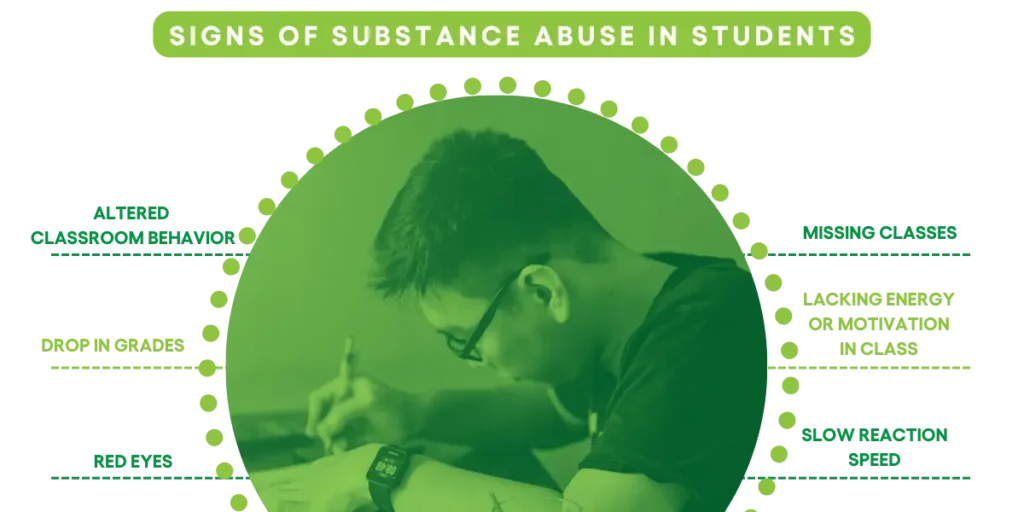
Teachers who want to monitor for signs of drug addiction in their students should look out for the following behavioral signs:
- Changes in typical classroom behavior
- Shifts in ability to complete workloads and homework
- Missing classes
- Sudden drop in grades
- Students lacking energy or motivation in class
- Students appearing to neglect their appearance
- Students asking to borrow money from teachers
Additionally, there are physical signs of addiction and students to watch out for, including:
- Red eyes
- Dry mouth
- Slow reaction speed
- Cannabis order on close
- Yellow fingertips
More overt signs of substance abuse in students include paranoia, panic attacks, hallucinations, and violent behavior.
If you are a teacher witnessing the signs of addiction in students, know that you are not alone in wanting the best possible outcome for them. At Southeastern Recovery Center, we’d be more than glad to help you come up with a list of resources to share with the students suffering from substance use disorder in order to ease them into receiving proper treatment.
While our facility is located in Charlotte, NC in Mecklenburg County, we serve individuals from all over the state. Through clinical programs such as Intensive Outpatient Program (IOP) or Partial Hospitalization Program (PHP) we can deliver treatment for drug or alcohol addiction with minimal disruptions to a student’s school-life balance.
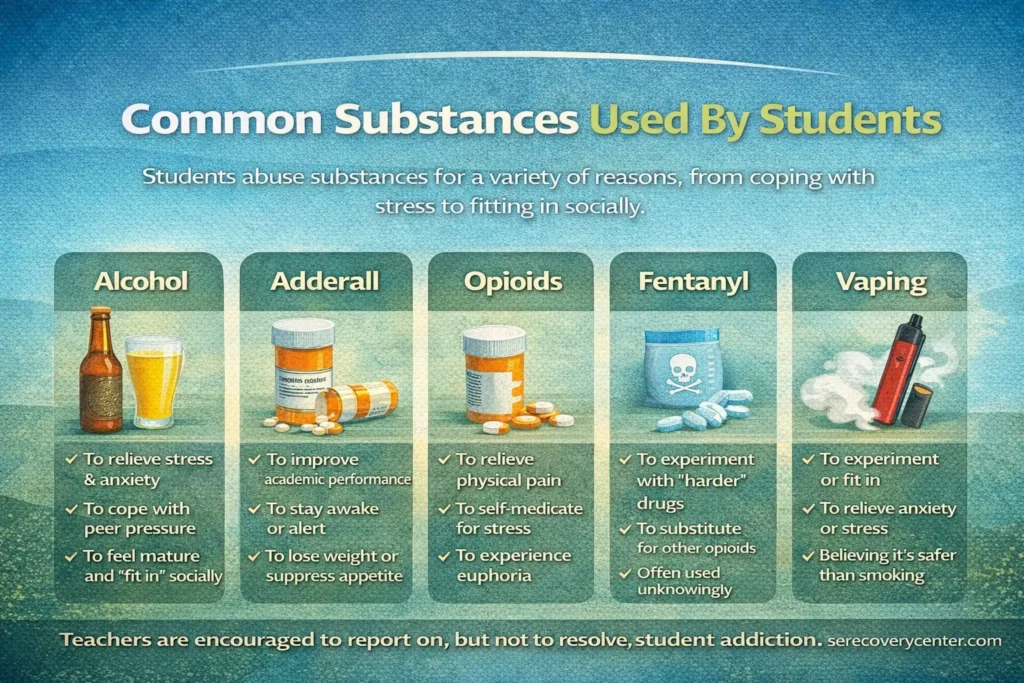
Common Substances Used by Students
Common substances used by students include:
The reasons why students use substances vary, from trying to self medicate for stress and anxiety to trying to improve classroom performance or even just to fit in with fellow students, succumbing to peer pressure.
While it’s important that teachers be able to recognize the types of drugs used by students, we don’t expect you to understand and resolve the underlying causes that lead to student drug use. Instead, you can leave that to treatment facilities like Southeastern Recovery Center, as we personalize treatment plans while tackling the underlying causes that lead to student drug abuse in the first place.
What Happens if a Teacher Doesn’t Address a Student’s Addiction Problem?
While we never want to say that a teacher is solely responsible for a student’s addiction problem, the fact of the matter is that in some cases, a teacher may be the only one who picks up on the signs of addiction in a student. In such a case, it’s possible that if a teacher ignores the issue, the student may fall further into addiction, which can lead to falling grades, erratic behavior, and eventual expulsion.
That’s why it’s not just on NC educators but on all of us to look out for signs of substance use disorders in students, friends, and coworkers. By working together, looking out for each other, and becoming informed advocates, we can help keep our community healthy, and help individuals who are struggling find treatment without paralyzing feelings of guilt or shame.
FAQs about The Teacher’s Guide to Addiction & Treatment (NC Edition)
Are teachers required to intervene if a student is suffering from drug addiction?
Teachers of younger students are considered mandated reporters and have to inform law enforcement or child protective services if they believe a student is being exposed to drugs or substances.
Can teachers provide drug addiction treatment to students?
No, teachers are generally unqualified to provide drug addiction treatment to their students.
How can a teacher help a student suffering from substance use disorder?
A teacher can help a student suffering from substance use disorder by speaking to them one on one, fostering a welcoming environment, and putting them in contact with treatment facilities like Southeastern Recovery Center.
What are some signs of drug addiction and students for teachers to watch out for?
Signs of drug addiction in students for teachers to watch out for include missing classes, sudden drops in grades, and students neglecting their appearance.
Sources:
Substance Abuse and Mental Health Services Administration. (2024). 2023 Companion infographic
report: Results from the 2021, 2022, and 2023 National Surveys on Drug Use and Health (SAMHSA Publication
No. PEP24-07-020). Center for Behavioral Health Statistics and Quality, Substance Abuse and Mental Health
Services Administration. https://www.samhsa.gov/data/report/2021-2022-2023-nsduh-infographic
Hui, T Keung. “1 in 10 NC Teachers Are Leaving the Profession. What It Means for Schools.” Raleigh News & Observer, Raleigh News & Observer, 4 Mar. 2026, www.newsobserver.com/news/local/education/article314910826.html.
“Resources for Mandated Reporters of Abuse.” Mandated Reporter, mandatedreporter.com.