
Natasha Lyonne, famous actress who starred in Peacock’s Poker Face, knows something about addiction and relapsing. The actress recently went public in January 2026, admitting that she had experienced a relapse after 10 years of sobriety. She did so in a very public manner, revealing it on the social media platform X (formerly known as Twitter).
At Southeastern Recovery Center, we understand that recovery from addiction to drugs and alcohol is an ongoing process. That’s precisely why we offer a full range of Aftercare Alumni services, in order to assure that our patients are armed with the tools they need to maintain their sobriety years after going through substance use disorder (SUD) treatment. Natasha Lyonne’s experience highlights how even famous celebrities can quietly struggle with addiction and can experience a relapse.
Article TL;DR: Natasha Lyonne coming clean about experiencing a relapse after 10 years of sobriety presents an opportunity for more individuals to understand that aftercare programs can help an individual maintain sobriety. In Lyonne’s own words, recovery is a process.
Article Preview:
Who is Natasha Lyonne? Natasha Lyonne is a famous actress best known for starring in Orange Is The New Black and Poker Face.
Natasha Lyonne’s Substance Use Disorders: What We Know. Tabloids have followed Natasha Lyonne’s struggles with substance use disorders for decades, including a DUI and being in intensive care is covered in track marks.
Why People Relapse After Recovering From Substance Use Disorders. People relapse after recovering from substance use disorders due to environmental triggers, high stress, and complacency after long-term success.
How Aftercare Programs Help Prevent Relapse. Aftercare programs help keep an individual on track through initiatives like monthly check ins and group therapy.
FAQs about Natasha Lyonne: The 10-Year Relapse. Learn answers to frequently asked questions about Natasha Lyonne and relapse after drug addiction treatment.
Who is Natasha Lyonne?
Natasha Lyonne is a famous actress, director, and comedian, who has starred in many popular TV shows and movies including Orange Is The New Black, Russian Doll, and most recently Poker Face. She was also recently announced to be joining the HBO TV series Euphoria as part of its new season three cast.
Natasha Lyonne’s Substance Use Disorders: What We Know
Natasha Lyonne has been publicly honest about some of her struggles with substance use disorder.
For example, she was once a child actress in some Hollywood productions such as American Pie, but she was arrested for DUI in 2001 after a crash in Miami Beach. She was only 23 years old at the time, and was fined in addition to being sentenced to six months probation 50 hours of community service, in addition to having a take part in a victim impact panel.
Then, in 2005, it was reported that Lyonne was in intensive care in the hospital due to suffering various negative effects due to “drugs and disease.” Hepatitis C, a heart infection, and a collapsed lung, along with the source saying that she was “covered in track marks.”
In 2012, Natasha Lyonne gave an interview where she admitted that “Spiraling into addiction is really, really scary.” In it, she alludes to possibly having dabbled in mixing different substances. The same year, she also mentioned having undergone open-heart surgery to repair a valve that was previously damaged “as a result of drug use.”
Since then, her career has been on the slow but steady upswing. This included her role as Nicky Nichols in the Netflix series Orange Is the New Black. Interestingly enough, Natasha Lyonne’s character suffered from the negative impact of longtime heroin use. As Lyonne herself stated:
“I feel very lucky to play Nicky. There’s no shortage of things for me to draw on when it comes to her back story.”
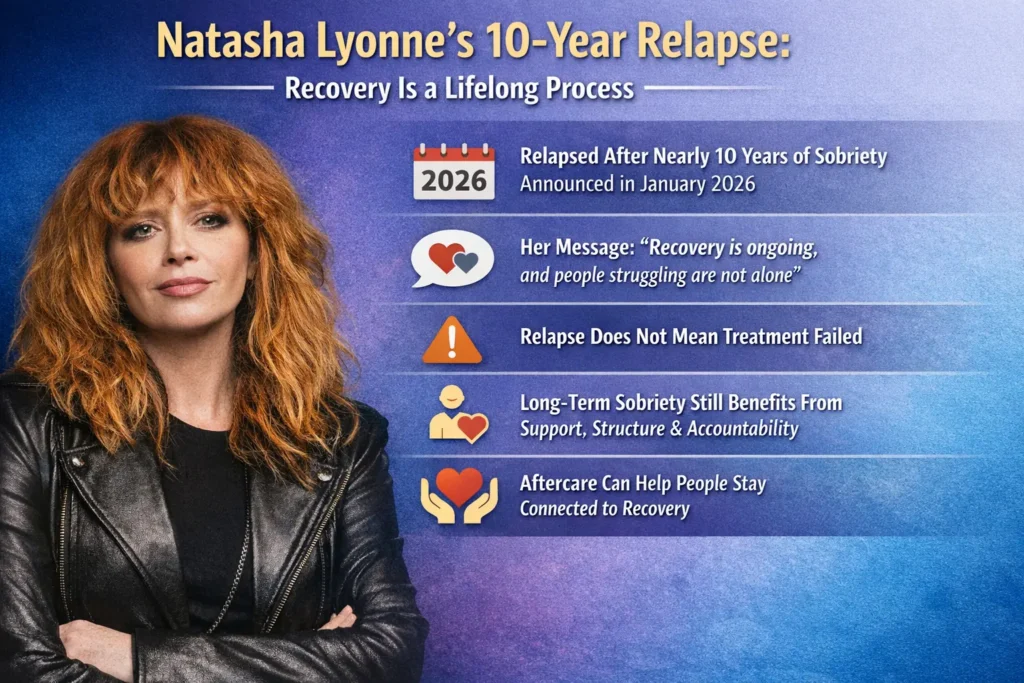
There was very little mention of Natasha Lyonne’s drug use in the past few years until her admittance that she had relapsed in 2026. As she herself stated, “Recovery is a lifelong process. Anyone out there struggling, remember you’re not alone.”
At Southeastern Recovery Center, we cannot agree more with the above two sentences. Our Charlotte, North Carolina facility is regularly visited by individuals who are hoping to cure their substance use disorders once and for all.
While we can help such people receive treatment for drugs and alcohol in NC, we always want to stress that they will have to continue taking efforts in their life to avoid relapsing afterwards. That’s why we encourage our patients to sign up for our Aftercare Alumni program to assure that they have access to the resources that they may or may not need to continue sober living.
Why People Relapse After Recovering From Substance Use Disorders

There are a variety of factors that lead to individuals relapsing after recovery from substance use disorders. They include:
- Exposure to environmental triggers
- Failure to address underlying mental health disorders contributing to substance use
- High stress
- Physiological factors
- Complacency after long-term success (believing that there’s no chance of triggers)
Because these reasons for relapse are many and varied, treatment for substance use disorders must address the underlying causes of an individual’s addiction. This kind of personalized treatment is the best way to improve the odds of long-term recovery, which is why it’s what we at Southeastern Recovery Center deliver for all of our patients.
That said, it’s important to recognize that relapse does not mean that treatment for drug or alcohol addiction has failed. Sometimes, all relapse means is that more support is needed.
Ways to help an individual that has relapsed can include having them join aftercare programs, testing out new science-backed treatments, and evaluating if an individual needs dual diagnosis care to address a mental health disorder in addition to their substance use disorder. Treatment facilities like Southeastern Recovery Center are equipped to handle all of these factors.
Common Relapse Triggers After Long-Term Sobriety and How Aftercare Helps
| Relapse Trigger After Long-Term Sobriety | What It Can Look Like | Why It Raises Relapse Risk | How Aftercare Can Help |
|---|---|---|---|
| Environmental triggers | Returning to places, people, routines, or situations tied to past drug or alcohol use | Familiar environments can reactivate cravings and old habits even after years of sobriety | Ongoing check-ins, relapse prevention planning, and trigger-management strategies help people respond before a lapse becomes a full relapse |
| High stress | Work pressure, relationship conflict, grief, financial strain, burnout, or major life changes | Stress can weaken coping skills and increase the urge to return to substance use for relief | Aftercare provides support, structure, and coping tools so stress is less likely to turn into a relapse |
| Untreated mental health symptoms | Anxiety, depression, trauma symptoms, mood instability, or emotional overwhelm | When mental health issues go untreated, substance use may re-emerge as a form of self-medication | Continued therapy, dual diagnosis support, and regular monitoring can help address the root causes of relapse |
| Complacency after long-term success | Feeling “cured,” skipping recovery routines, or assuming relapse is no longer possible | Long periods of sobriety can sometimes create overconfidence and reduce day-to-day recovery habits | Aftercare reinforces that recovery is a lifelong process and helps people stay engaged with sober living routines |
| Isolation | Pulling away from support systems, meetings, therapy, or sober peers | Isolation can make it easier for cravings, shame, or secrecy to grow without intervention | Alumni programs, peer groups, and follow-up support help people stay connected and accountable |
| Physiological and brain-based recovery challenges | Ongoing cravings, stress sensitivity, sleep disruption, or slow recovery in brain function | Substance use disorder can have long-term effects on brain chemistry, making relapse vulnerability persist over time | Aftercare gives people long-term recovery support while the brain and body continue healing |
| Shame after a lapse | Hiding a slip, avoiding help, or believing one mistake means total failure | Shame can turn a brief lapse into a prolonged relapse by keeping people from asking for help quickly | Aftercare reminds people that relapse does not mean treatment failed and encourages fast re-engagement with support |
| Lack of accountability | No follow-up after treatment, no sober community, and no one noticing early warning signs | Without outside support, small warning signs can escalate before anyone intervenes | Regular touchpoints, group therapy, and alumni engagement create accountability that helps catch problems early |
How Aftercare Programs Help Prevent Relapse
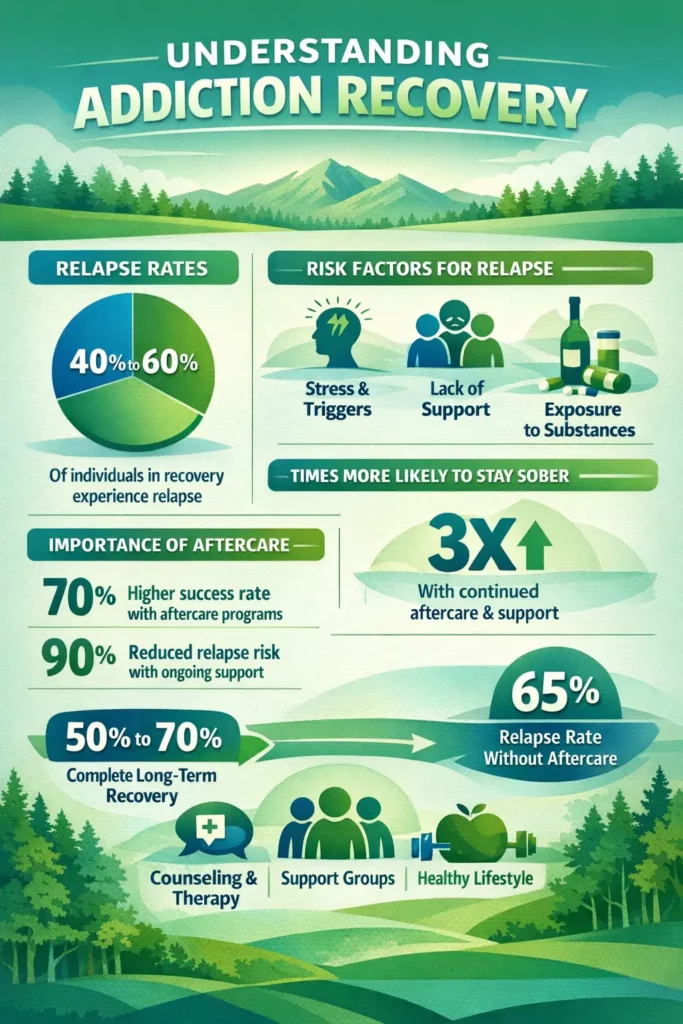
40–60% of people relapse within their first year of recovery without ongoing support. That said, the odds of relapsing after drug and alcohol addiction treatment decrease the longer an individual maintains sobriety.
Even so, there’s always a chance that something might trigger an individual to return to their old substance use habits. This is why enrollment in aftercare programs can be so beneficial.
In the short term, aftercare programs for individuals who have completed drug or alcohol addiction treatment can help them return to sobriety. While their brain’s recovering normal function thanks to a lack of illicit substances, aftercare treatment such as check-in calls, group therapy, and a 24/7 crisis hotline can help prevent relapse.
In the long term, aftercare programs remind an individual that maintaining sobriety will be an ongoing process. So long as they don’t allow themselves to grow complacent, they can continue to fight off relapsing into old substance use habits.
Remember: substance use disorder is a result of drugs or alcohol rewiring brain chemistry. It taking time to bounce back from these effects is no cause for feelings of guilt or shame. Recovery is an ongoing process, and treatment facilities like Southeastern Recovery Center can help you or your loved ones with it.
From ten days after treatment to two years to ten years, whether you’re a regular individual or Natasha Lyonne yourself, there’s room to benefit from using an aftercare program on your sobriety journey.
FAQs about Natasha Lyonne: The 10-Year Relapse
Who is Natasha Lyonne?
Natasha Lyonne is a famous actress known for starring in Orange is the New Black and Pokerface.
Why did Natasha Lyonne relapse?
We do not know why Natasha Lyonne relapsed, we do know that she relapsed after 10 years of sobriety.
What kind of substances did Natasha Lyonne take?
While Natasha Lyonne has not given us the full list of substances she used, we do know that she received treatment for heroin use disorder at minimum, and was arrested in 2001 for driving under the influence of alcohol.
Do aftercare programs help prevent relapse after receiving treatment for drug or alcohol addiction?
Yes, aftercare programs can help prevent relapse after receiving treatment for drug or alcohol addiction.
Sources:
Natasha Lyonne Pleads Guilty to DUI. The Associated Press. https://www.theintelligencer.com/news/article/Natasha-Lyonne-Pleads-Guilty-to-DUI-10484467.php.
“Natasha Lyonne: ‘I Was Definitely as Good as Dead.’” EW.Com, 30 Mar. 2012, https://ew.com/article/2012/03/30/natasha-lyonne-american-reunion-drugs/.
“NATASHA’S HELL – ‘MISSING’ STAR FOUND IN DOWNTOWN HOSP FACING DESPERATE DRUG AND HEALTH CRISIS.” New York Post, 19 Aug. 2005, https://nypost.com/2005/08/19/natashas-hell-missing-star-found-in-downtown-hosp-facing-desperate-drug-and-health-crisis/.
National Institute on Drug Abuse. “Treatment and Recovery.” National Institute on Drug Abuse (NIDA), 6 Jul. 2020, https://nida.nih.gov/publications/drugs-brains-behavior-science-addiction/treatment-recovery.