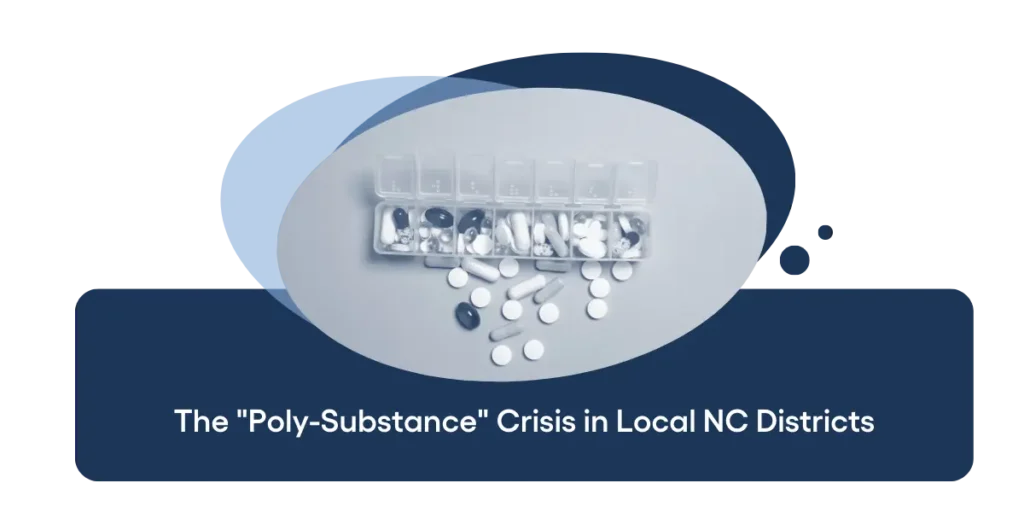
The idea that tackling substance use disorders is as simple as identifying and combating one specific drug is outdated, as evidenced by the polysubstance crisis in local North Carolina districts. Polysubstance use refers to the use of multiple substances over a singular timeframe, including the mixing of numerous illicit drugs. Polysubstance use disorder can be as dangerous as mixing fentanyl with stimulants like cocaine or methamphetamine, which can be driven by factors as complex as individuals attempting to self-medicate for stress, pain relief, or to combat mental health disorders.
At Southeastern Recovery Center, the rise in polysubstance use serves as part of our reasoning in adopting dual diagnosis care. As polysubstance use disorder continues rising in local NC districts, dual diagnosis care will become increasingly mandatory to address the complex neurological impact that multiple substances and mental health triggers can have on an individual, creating a “cross-addiction.”
Article TL;DR: Polysubstance use is one of the most dangerous ways to engage with illicit substances. Treatment facilities like Southeastern Recovery Center and initiatives sponsored by the North Carolina Department of Health and Human Services are combating the polysubstance crisis in local NC districts.
Article Preview:
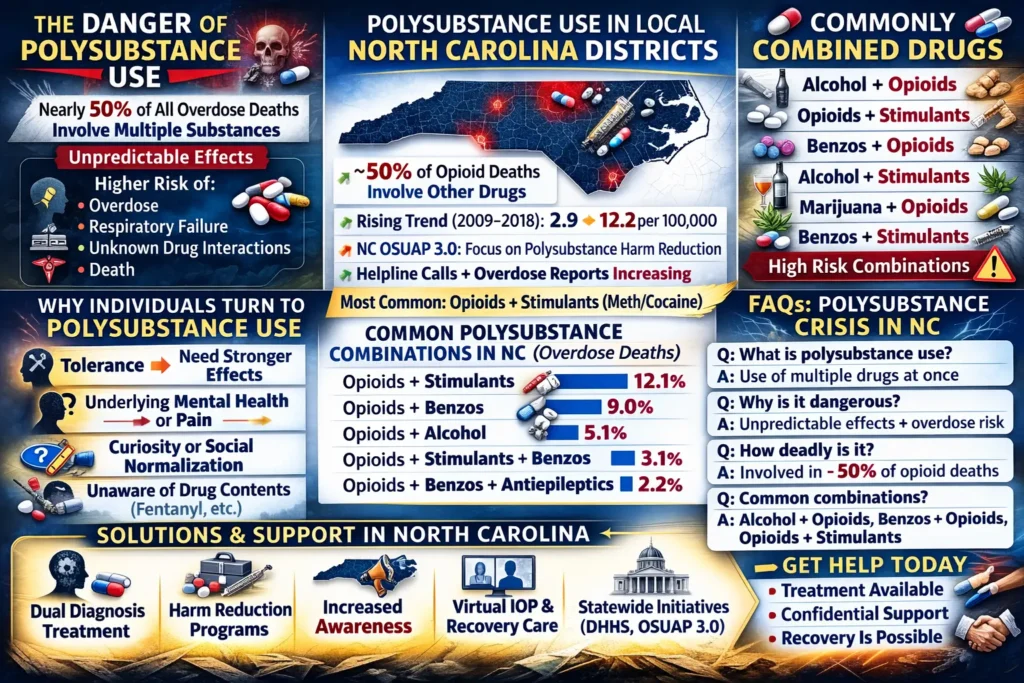
The Danger Of Polysubstance Use. Polysubstance use presents a unique danger due to the unpredictability of mixing drugs.
Polysubstance Use In Local North Carolina Districts. North Carolina has been actively fighting polysubstance use, and nearly half of all opioid overdose deaths involve other substances.
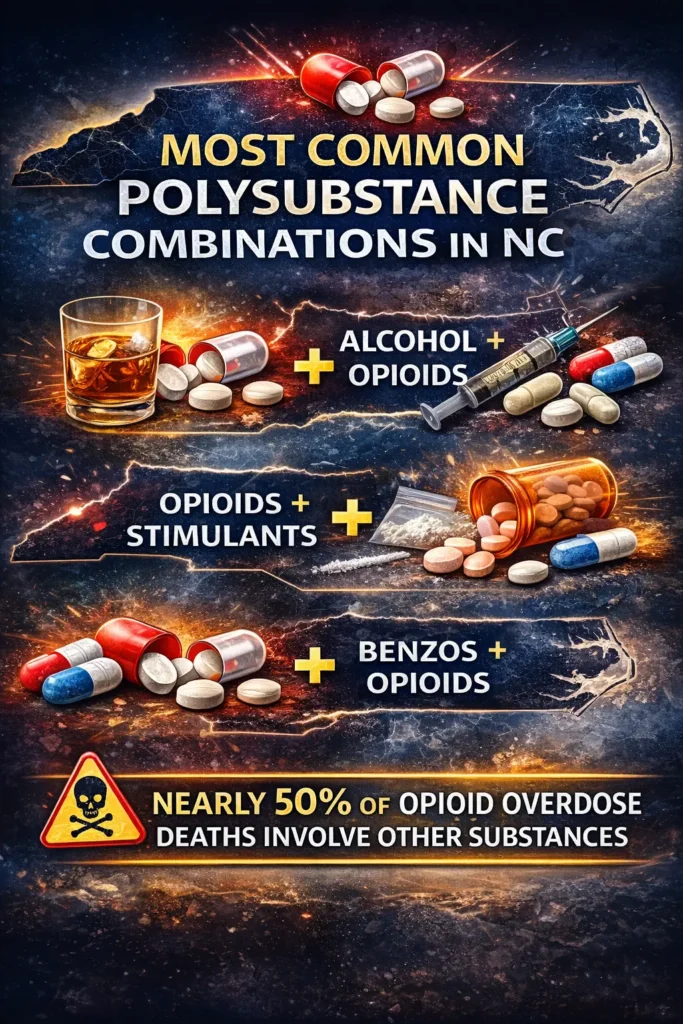
Commonly Combined Drugs for Polysubstance Use. Commonly combined substances in polysubstance use include alcohol with opioids, opioids with stimulants, and benzodiazepines with opioids.
Why Individuals Turn To Polysubstance Use. Individuals may turn to polysubstance use because they’ve developed a tolerance to a specific drug or are ignorant to the danger of polysubstance use.
FAQs About The “Polysubstance” Crisis In Local NC Districts. Learn answers to frequently asked questions about the polysubstance crisis in local North Carolina districts.
The Danger Of Polysubstance Use
Polysubstance use is extremely dangerous because mixing drugs can result in more potent and more unpredictable effects. Nearly half of all drug overdose deaths in 2022 involved polysubstance use.
Additionally, street drugs that are manufactured in labs (such as kratom or synthetic opioids like fentanyl) are famously unregulated. This means that individuals may already be dealing with one substance that has been combined with others. The result of trying to combine even more drugs could lead to serious health risks.
At Southeastern Recovery Center, we often advise our patients on the benefits of tackling the underlying reasons that they’re seeking out illicit substances in the first place. Mental health disorders, stress, and pain are a few common factors that push individuals towards substances, can then lead to a dependence, then an addiction, and potentially a polysubstance use disorder. Ultimately, there are always healthier ways of coping rather than turning to substance use.
Polysubstance Drug Combinations That Increase Overdose Risk in North Carolina
| Polysubstance Combination | Example Substances | NC / Research Context | Why It’s Dangerous |
|---|---|---|---|
| Opioids + Stimulants | Heroin or fentanyl with cocaine or methamphetamine | Identified as the most common polysubstance overdose combination in one North Carolina study; 12.1% of overdose deaths | Can put intense strain on the body by combining opposing drug effects and increasing overdose risk |
| Opioids + Benzodiazepines | Oxycodone, heroin, or fentanyl with Xanax, Valium, or Klonopin | Accounted for 9.0% of overdose deaths in a North Carolina study | Both can suppress breathing and increase risk of fatal overdose |
| Opioids + Alcohol | Prescription opioids, heroin, or fentanyl with alcohol | Accounted for 5.1% of overdose deaths in a North Carolina study | Mixing depressants can severely slow breathing, reaction time, and consciousness |
| Opioids + Stimulants + Benzodiazepines | Opioids with cocaine or methamphetamine plus Xanax or another benzo | Accounted for 3.1% of overdose deaths in a North Carolina study | Creates highly unpredictable effects and can overwhelm the heart, brain, and respiratory system |
| Opioids + Benzodiazepines + Antiepileptics | Opioids with benzodiazepines and seizure-control medications | Accounted for 2.2% of overdose deaths in a North Carolina study | Multiple central nervous system depressants may compound sedation and overdose danger |
| Alcohol + Opioids | Drinking while using opioids | Also highlighted in broader substance-mixing education as a common high-risk pattern | Can amplify sedation and make overdose more likely |
| Benzodiazepines + Opioids | Anti-anxiety medication mixed with opioids | Repeatedly identified in overdose and treatment discussions as a high-risk combination | Strongly linked to respiratory depression |
| Alcohol + Stimulants | Alcohol with cocaine, methamphetamine, amphetamines, or MDMA | Commonly discussed as a frequent form of polysubstance use | One drug can mask the effects of the other, leading people to take more than intended |
| Marijuana + Opioids | Cannabis with heroin, fentanyl, or prescription opioids | Listed among common substance combinations in polysubstance education materials | Can impair judgment and increase risk-taking around other drugs |
| Nicotine + Alcohol or Other Drugs | Tobacco or nicotine products with alcohol, marijuana, opioids, or benzodiazepines | Often appears alongside other substance use patterns | Can reinforce dependence behaviors and normalize multi-substance use |
Polysubstance Use In Local North Carolina Districts
North Carolina has been sounding the alarm on polysubstance use for a while now. In 2025, the North Carolina Department of Health and Human Services released a report that detailed how the Opioid and Prescription Drug Abuse Advisory Committee hosted a harm reduction Academy that covered, among other topics, polysubstance use. Additionally, part of the Opioid and Substance Use Action Plan (OSUAP) 3.0 aims to reduce harm in North Carolina by “expanding the focus beyond opioids to address polysubstance use.”
- Studies have shown that nearly half of all opioid overdose deaths involve other substances. Most commonly, individuals are combining opioids with stimulants such as methamphetamine or cocaine.
- Polysubstance involvement is less common in adolescent opioid overdose deaths.
- A 2018 study found that polysubstance overdose deaths increased between 2009 and 2018 in North Carolina, rising from a rate of 2.9 per 100,000 persons to 12.2 per 100,000 persons
At Southeastern Recovery Center, our aim is to help individuals suffering from polysubstance use disorder across the entire state, not just those who live within Mecklenburg County. Through the use of personalized treatment plans and varied methodologies such as dual diagnosis care and virtual IOP, we’re able to provide care to anyone suffering from polysubstance use disorder in NC. If you or a loved one is mixing substances, please reach out and know that the journey to addiction recovery doesn’t have to be taken alone.
Commonly Combined Drugs for Polysubstance Use
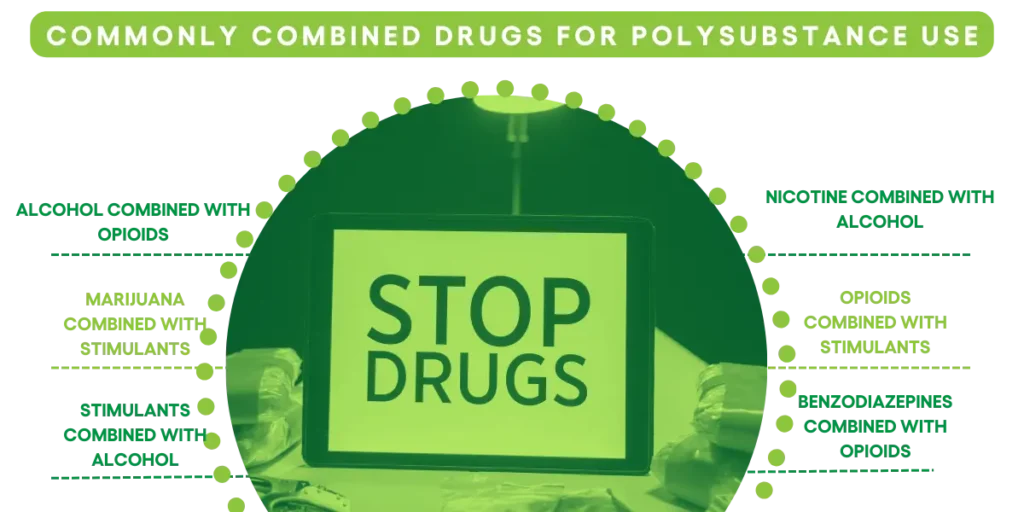
Part of combating polysubstance use in NC requires understanding which substances are typically combined. These include:
- Alcohol combined with opioids, stimulants (methamphetamines, amphetamines, MDMA), or marijuana
- Nicotine combined with alcohol, marijuana, opioids, or benzodiazepines
- Marijuana combined with stimulants, alcohol, or opioids
- Opioids combined with stimulants, alcohol, benzodiazepines, or marijuana
- Stimulants combined with alcohol, marijuana, opioids, or benzodiazepines
- Benzodiazepines combined with opioids or stimulants
Unfortunately, research has shown that combining multiple substances is more common than one might think. For example, the University of North Carolina’s online library hosts a 2026 study about the need to incorporate Polysubstance use in neuropsychopharmacology research. In it, researchers bring up numerous facts such as epidemiological studies pointing out that:
- 70-95% of individuals with alcohol use disorder use tobacco daily
- Upwards of 60% of individuals who use cocaine have a comorbid alcohol use disorder
The link between substances extends beyond nicotine and alcohol. A 2018 study in North Carolina studied overdose deaths and uncovered the following common polysubstance combinations:
- Opioids and stimulants (12.1% of overdose deaths)
- Opioids and benzodiazepines (9.0% of overdose deaths)
- Opioids and alcohol (5.1% of overdose deaths)
- Opioids, stimulants, and benzodiazepines (3.1% of overdose deaths)
- Opioids, benzodiazepines, and antiepileptics (2.2% of overdose deaths)
This study disproportionately represented polysubstance combinations with opioids because the study overdose deaths, and opioids account for almost 80% of all overdose deaths in the world.
Why Individuals Turn To Polysubstance Use
There are a couple of different reasons why individuals turn to polysubstance use.
One reason is that an individual may have grown tolerant to a specific drug, and thus may want to combine different drugs in order to feel whatever effect they are chasing. Unfortunately, this then places their life at risk.
It’s also possible an individual may develop a polysubstance use disorder by accident. The fact that certain drugs like fentanyl are commonly mixed with other drugs can mean that individuals may partake in polysubstance use without intending to.
Another factor is how polysubstance use is more normalized in certain situations than others. For example combining alcohol with smoking is fairly common in society. Yet this can have a normalizing effect on individuals, causing them to be less wary when it comes to inviting other substances that are more dangerous.
If you or a loved one are engaging in polysubstance use, it’s important to recognize that there are much healthier ways of coping with any underlying factors.
At Southeastern Recovery Center, we’re more than capable of addressing any underlying causes of polysubstance use disorder. Through the use of dual diagnosis care, we can help an individual remedy the complexities involved in an addiction to multiple substances as well as any underlying mental health triggers that could be driving their cross-addiction.
FAQs About The “polysubstance” Crisis In Local NC Districts
What is polysubstance use?
Polysubstance use is the combining of different illicit substances.
Why is polysubstance use dangerous?
Polysubstance use is dangerous because it can have unpredictable effects on an individual, and many illicit drugs have chemical makeups that are unknown and fluctuate already.
How deadly is polysubstance use?
Polysubstance use makes up almost half of all opioid overdose deaths.
What are some commonly combined substances in polysubstance use disorder?
Commonly combined substances in polysubstance use disorder include alcohol combined with opioids, opioids combined with stimulants, and benzodiazepines combined with opioids.
Sources:
Buchholz, Connor., et al. Polysubstance-Involved Opioid Overdose Deaths Among US Youths: 2020 to 2023. Pediatrics Logo, https://publications.aap.org/pediatrics/article-abstract/156/2/e2024070433/202428/Polysubstance-Involved-Opioid-Overdose-Deaths?redirectedFrom=fulltext.
Figgatt, Mary C., et al. “Trends in Unintentional Polysubstance Overdose Deaths and Individual and Community Correlates of Polysubstance Overdose, North Carolina, 2009-2018.” Drug and Alcohol Dependence, vol. 219, Drug and alcohol dependence, 1 Feb. 2021, pp. 108504–108504, https://doi.org/10.1016/j.drugalcdep.2020.108504.
Polysubstance Fact Sheet Unlocked. impactcarolina.org, https://impactcarolina.org/wp-content/uploads/Polysubstance-Fact-Sheet-Unlocked.pdf.
Performance of North Carolina’s System for Monitoring Opioid and Prescription Drug Abuse. ncdhhs.gov, https://www.ncdhhs.gov/sl-2017-57-section-11f10-opioid-prescription-drug-abuse-monitoring-annual-report-2/download?attachment.
The need to incorporate polysubstance use in neuropsychopharmacology research: biological lessons and new opportunities. Joffe, Max E., et al. unc.edu, https://cdr.lib.unc.edu/concern/articles/tm70nb51m?locale=en.