Boys and men make up about one-third of all people with eating disorders and male actors are not immune to this statistic.
When people picture celebrities with eating disorders, they usually think of actresses — not male actors. But that stereotype leaves out a huge part of reality, including the millions of boys and men who struggle with food, body image, and control and rarely feel like they’re “allowed” to talk about it.
Males represent roughly 20% of anorexia cases, 30% of bulimia, and over 40% of binge eating disorder.
Experts agree the numbers don’t paint an accurate picture because male eating disorders are often misdiagnosed, ignored, or hidden due to stigma. That’s why it matters when well-known men speak out. Their stories remind us that male eating disorders are real, serious, and treatable.
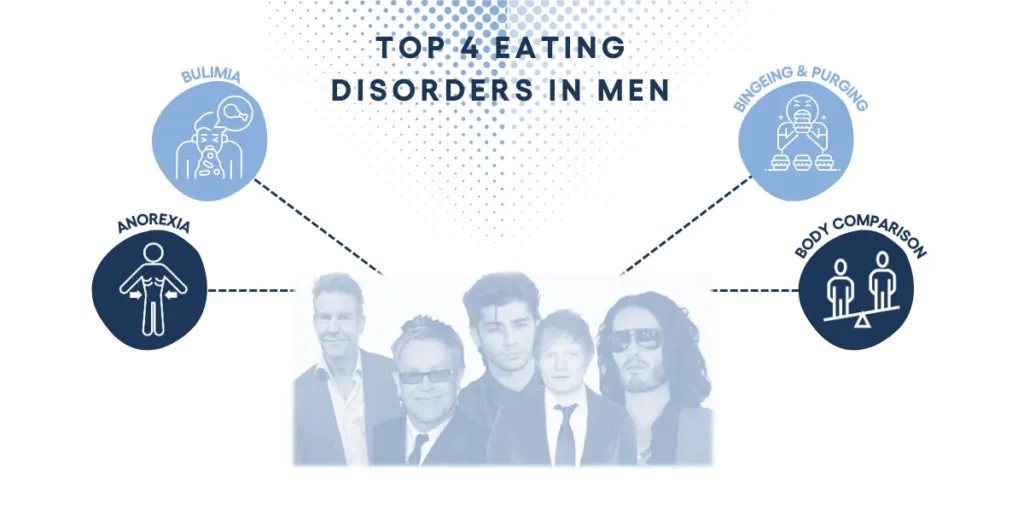
The Hidden Reality of Male Eating Disorders
Male eating disorders are often overlooked because:
- Different body ideals: Many men pursue leanness or muscle rather than “thinness,” which can mask disordered behaviors as “fitness.”
- Stigma: Men often feel embarrassed or ashamed to admit they’re struggling, since eating disorders are stereotyped as a “women’s problem.” This stigma can often delay treatment.
- Underdiagnosis: Research shows men are less likely to be screened, even with obvious symptoms.
Anorexia
Anorexia often gets reduced to “not eating,” but it’s much more complicated than that. For many people — including men — anorexia becomes a way to feel in control when everything else feels overwhelming. It shows up as extreme dieting, fear of weight gain, obsessive thoughts about food, or exercising far past the point of exhaustion. What makes anorexia especially dangerous is how quietly it can take hold; someone can be praised for “discipline” long before anyone realizes they’re actually starving their body. The truth is, anorexia isn’t a lifestyle or a phase — it’s a serious illness that deserves real, professional support.
It’s estimated that 10%–25% of anorexia nervosa cases are in males (though data is limited).
Bulimia
Bulimia is often misunderstood because it tends to happen behind closed doors. People with bulimia may go through cycles of eating large amounts of food and then trying to “undo” it through vomiting, laxatives, or extreme exercise. These behaviors aren’t about vanity — they’re about trying to escape guilt, shame, anxiety, or emotional overload. Many men with bulimia go undiagnosed because the disorder hides beneath humor, “bulking and cutting,” or the belief that guys should just “push through it.” Recognizing bulimia means understanding it’s not a lack of willpower; it’s a sign someone is fighting a battle they can’t win alone.
The lifetime prevalence of Bulimia Nervosa among U.S. adults is about 1.0%, and past-year prevalence for males is around 0.1%, compared with 0.5% for females.
Bingeing and Purging
Bingeing and purging can trap someone in a cycle that feels impossible to break. A binge often starts with restriction — skipping meals, limiting foods, or trying to “be good.” Then hunger, emotions, or stress hit all at once, leading to a loss of control around food. The purge becomes a desperate attempt to erase what happened or soothe the shame that follows. Men especially struggle to admit they’re caught in this cycle because it clashes with how they think they’re “supposed” to handle emotions. But bingeing and purging is a sign of pain — not weakness — and it deserves compassion, not judgment.
Among adult males, past-year prevalence of binge-eating disorder is estimated at 0.8%, compared with 1.6% for females.
Body Comparison
Body comparison can be just as damaging as any eating disorder behavior, especially for men who feel pressured to look “lean,” “shredded,” or permanently gym-ready. Social media, celebrity culture, and even fitness trends push the idea that a certain kind of body equals success or discipline. For many men, this pressure turns into constantly checking mirrors, comparing themselves to others, or feeling “not good enough” no matter how hard they try. Body comparison slowly chips away at confidence and can trigger restrictive eating, over-exercising, or bingeing. Learning to break that cycle starts with recognizing that someone else’s body isn’t a rulebook — it’s just their body.
According to the American Psychological Association, boys and men now make up about one-third of those diagnosed with an eating disorder.
Breaking the myths about male eating disorders is critical — and there are five male celebrities who help shine a light on the issue.
1. Dennis Quaid — “Manorexia” and Hollywood Pressure
Actor Dennis Quaid revealed he struggled with what he called “manorexia” while preparing for a role in the 1990s. He lost about 40 pounds for Wyatt Earp and continued restricting even after filming ended. Hollywood body expectations can push actors — including men — into dangerous territory that evolves into full-blown eating disorders.
2. Elton John — Bulimia and Emotional Coping
Music icon Elton John has spoken candidly about his years-long battle with bulimia, which overlapped with his struggles with alcohol and drugs. His story highlights how eating disorders and addiction often intersect — and why recovery must address both.
3. Russell Brand — Bulimia Beginning at Age 11
Comedian and actor Russell Brand revealed he began bingeing and purging at age 11, describing how isolating and embarrassing it felt because he believed “boys didn’t get eating disorders.” Eating disorders in boys often go undetected for years. Brand’s honesty shows the importance of early recognition and intervention.
4. Zayn Malik — Restriction During One Direction Fame
Singer Zayn Malik described experiencing a severe eating disorder during One Direction’s peak, explaining that he would go long periods without eating and felt completely out of control. His experience underscores how emotional overload, public pressure, and lack of autonomy can fuel disordered eating.
5. Ed Sheeran — Binge Eating, Purging, and Body Comparison
Ed Sheeran revealed in a Rolling Stone interview that he struggled with binge eating and purging, admitting, “I have a real eating problem.” He connected it to comparing himself with other male performers and feeling pressure to look a certain way. Binge eating disorder is especially common among men — and Sheeran’s total honesty helps break down stigma.
Why These Stories Matter
These male celebrities with eating disorders show that:
- Eating disorders don’t discriminate by gender.
- Men struggle with anorexia, bulimia, binge eating disorder, and compulsive exercise — but are less likely to receive treatment.
- Shame, silence, and stereotypes delay help.
- Recovery begins with honesty and professional support.
Actors, musicians, and athletes often face additional pressures around body image, performance, and control — making early support even more essential.
Common Signs of an Eating Disorder in Men
- Extreme dieting or fasting
- Secret binge eating
- Purging (vomiting, laxatives, over-exercising)
- Shame around eating
- Hyper-fixation on “clean” eating or macros
- Avoiding meals with others
- Rapid weight changes
- Compulsive exercise or body checking
If any of these hit close to home, it’s not about “discipline.” It may be an eating disorder — and help is available.
Getting Help for Male Eating Disorders
Reliable resources for help with male eating disorders include:
Southeastern Recovery Center Can Help
If you or someone you love is struggling with disordered eating, body image concerns, or co-occurring mental health challenges, Southeastern Recovery Center offers compassionate, evidence-based support tailored to your needs.
Our team provides:
- Individual and group therapy
- Trauma-informed, gender-inclusive care
- Nutritional guidance and relapse-prevention skills
- A full continuum of recovery-focused services
- A safe, supportive environment for healing
You don’t have to wait for things to get worse. Reach out today and let our team walk with you toward recovery.
Sources:
“The Alliance for Eating Disorders Awareness.” The Alliance for Eating Disorders, www.allianceforeatingdisorders.com/. Accessed 23 May 2024.
“Eating Disorders.” National Institute of Mental Health, Mar. 2023, www.nimh.nih.gov/health/statistics/eating-disorders.
“Eating Disorders in Boys and Men.” American Psychological Association, www.apa.org/topics/eating-disorders/boys-men. Accessed 23 May 2024.
“Eating Disorders in Males.” National Eating Disorders Collaboration, nedc.com.au/eating-disorders/eating-disorders-explained/eating-disorders-in-males. Accessed 23 May 2024.
“Eating Disorders in Men and Boys.” National Eating Disorders Association, www.nationaleatingdisorders.org/eating-disorders-in-men-and-boys. Accessed 23 May 2024.
“Elton John Regrets Past Drug Use.” Rolling Stone, 25 Oct. 2010, www.rollingstone.com/music/music-news/elton-john-regrets-past-drug-use-105873/.
France, Lisa Respers. “Zayn Malik Reveals He Had an Eating Disorder.” CNN, 1 Nov. 2016, www.cnn.com/2016/11/01/entertainment/zayn-malik-eating-disorder-one-direction.
Heigl, Alex. “Dennis Quaid Opens Up About His Past Struggle with Anorexia: ‘I Was Doing It to Myself.’” People, 18 June 2017, people.com/health/dennis-quaid-workout-age-63/.
Hiatt, Brian. “Ed Sheeran’s Lost Decade and His Survival Strategy.” Rolling Stone, 21 Mar. 2023, www.rollingstone.com/music/music-features/ed-sheeran-new-album-subtract-tour-cover-story-interview-1234694319/.
Lewis, Paul. “It’s Not Just Women – Men Can Get Eating Disorders Too.” The Guardian, 18 June 2006, www.theguardian.com/media/2006/jun/18/broadcasting.arts.
“National Eating Disorders Association.” NEDA, www.nationaleatingdisorders.org/. Accessed 23 May 2024.
“Statistics.” National Eating Disorders Association, www.nationaleatingdisorders.org/statistics/. Accessed 23 May 2024.
“Statistics for Anorexia in Men and Boys.” Bulimia.com, bulimia.com/anorexia/statistics/men-boys. Accessed 23 May 2024.