The three warning signs are 1) Loss of Control Over Drinking, 2) Increased tolerance to Alcohol, and 3) Continued Drinking Despite Negative Consequences.
At Southeast Recovery Center, we understand that identifying the line between social drinking and a serious problem can be difficult. Alcoholism, clinically known as Alcohol Use Disorder (AUD) is a progressive disease that often develops in stages. Because it can be subtle at first, many people don’t realize they need help until alcohol has already begun to impact their health and happiness.
Recognizing the symptoms early is the most effective way to prevent long-term damage. Below, our clinical team breaks down the three primary warning signs that indicate it may be time to seek professional support.

The most telling sign of a developing struggle with alcohol is the loss of the “off switch.” When a person loses control, drinking is no longer a conscious choice but a physical and psychological compulsion.
What to look for:
The Clinical Perspective: Loss of control indicates that the brain’s reward system has been hijacked. At this stage, alcohol is being prioritized by the brain as a survival need, making it incredibly difficult to stop without professional intervention.

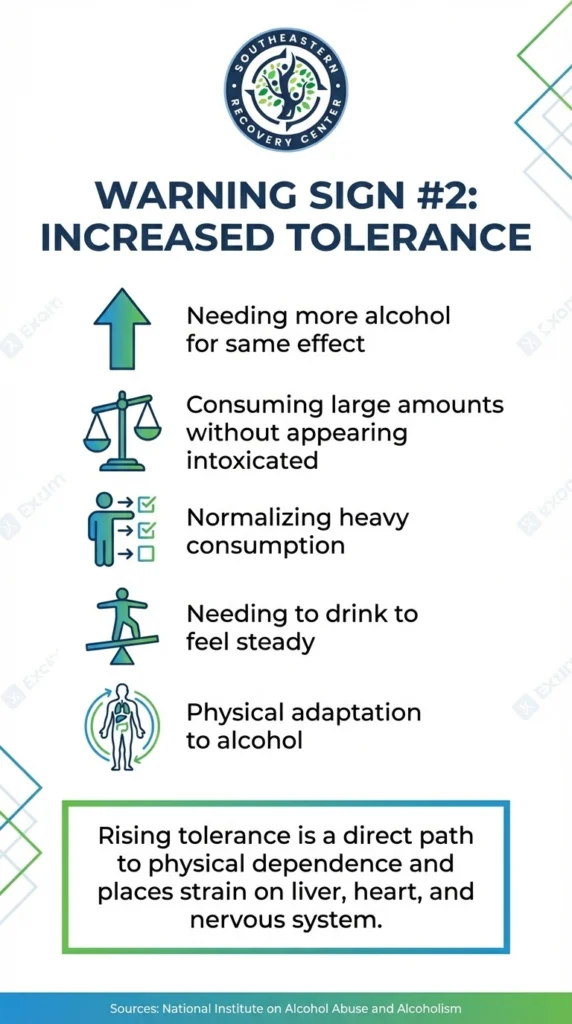
Tolerance occurs when the brain and body adapt to the constant presence of alcohol. Over time, you require larger and larger amounts of alcohol to achieve the same “buzz” or level of relaxation you once felt with just one or two drinks.
Common indicators include:
Why this is a warning sign: Rising tolerance is a direct path to physical dependence. It places immense strain on your liver, heart, and nervous system, and it often masks the true level of damage being done to the body.
This sign is often the most heartbreaking for families. It occurs when an individual continues to use alcohol even though it is clearly causing significant problems in their life.
Common indicators include:
Why it matters: When alcohol takes precedence over your livelihood and your loved ones, it is a clear indicator of a deep-seated dependency. This stage signals that the “functioning” phase is ending and clinical support is needed to break the cycle safely.

At Southeast Recovery Center, we see firsthand how early intervention changes lives. Because alcoholism is a progressive condition, it does not improve on its own. Identifying these signs today can:
Many people wait for a “rock bottom” moment to seek help. However, you don’t have to lose everything to start getting better. Whether you are “high-functioning” or in a moment of crisis, help is available.
If you or someone you care about is showing these signs, it is an opportunity for a new beginning, not a cause for shame. Our compassionate team at Southeast Recovery Center offers evidence-based treatment programs—including PHP, IOP, and Dual Diagnosis care, designed to help you reclaim your life.
Sources
American Psychiatric Association. Diagnostic and Statistical Manual of Mental Disorders,
5th ed., text rev., American Psychiatric Publishing, 2022.
National Institute on Alcohol Abuse and Alcoholism. Alcohol Use Disorder (AUD),
National Institutes of Health,
https://www.niaaa.nih.gov/publications/brochures-and-fact-sheets/alcohol-use-disorder.
National Institute on Drug Abuse. Drugs, Brains, and Behavior: The Science of Addiction,
National Institutes of Health,
https://nida.nih.gov/research-topics/drugs-brains-behavior-science-addiction.
Mayo Clinic. Alcohol Use Disorder. Mayo Foundation for Medical Education and Research,
https://www.mayoclinic.org/diseases-conditions/alcohol-use-disorder/symptoms-causes/syc-20369243.
Substance Abuse and Mental Health Services Administration. Alcohol Use Disorder,
U.S. Department of Health and Human Services,
https://www.samhsa.gov/substance-use/alcohol.