
Gambling addiction, often referred to as gambling disorder, is a serious and progressive condition that can quietly take a toll on a person’s emotional well-being, financial stability, and relationships. With the growing accessibility of gambling, especially through legalized online sports betting and the continued presence of in-person casinos and gaming venues in North Carolina, it’s becoming easier than ever for people to slip into harmful patterns without even realizing it.
A 2023 report from the National Council on Problem Gambling estimates that approximately 2.2% of adults in North Carolina struggle with a gambling problem.
At Southeastern Recovery Center, we understand how overwhelming and isolating gambling-related struggles can feel, especially as legalized sports betting continues to expand in North Carolina. While we do not provide formal treatment for gambling addiction, we recognize the growing need for support. Our team is committed to helping individuals find the right path forward by offering guidance, referrals, and trusted resources for those seeking help. Whether someone is beginning to question their gambling habits or has been struggling for years, we’re here to provide understanding, not judgment, and to connect them with the support they deserve.
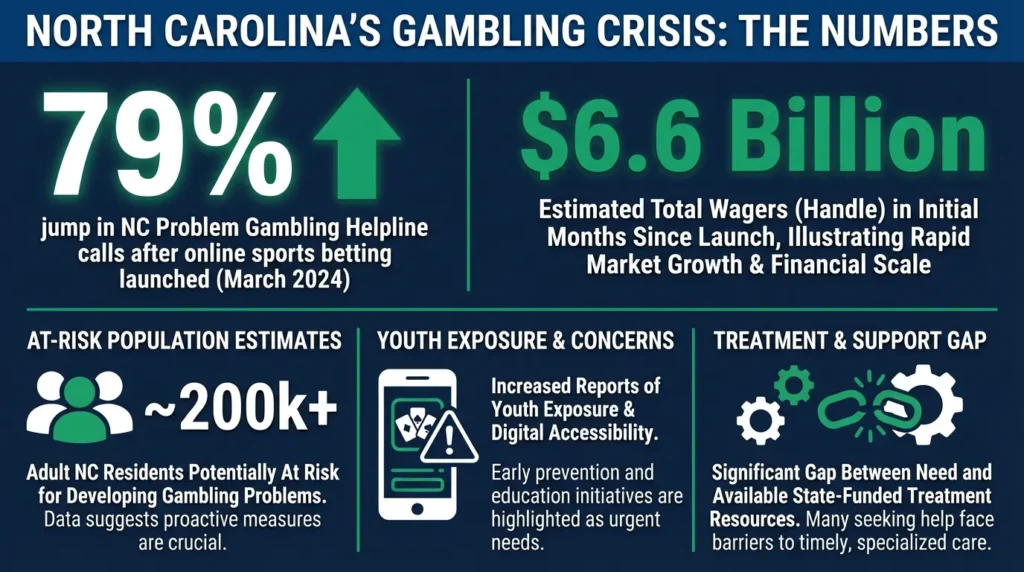
North Carolina entered a new era of gambling in March 2024 when regulated online sports betting launched statewide, and the data since then show a measurable rise in gambling-related harm across the state and the Charlotte region. From surging helpline volumes to rapidly shifting caller demographics, these figures reveal how quickly legalized betting is reshaping the public health landscape for Mecklenburg County residents and beyond. The table below draws on state agency data, federal surveys, and peer-reviewed research to document where things stand.
| Gambling Activity or Harm Indicator | Reported Rate or Volume | Geographic Level |
|---|---|---|
| NC adults estimated to struggle with a gambling problem | Approx. 2.2% of adults, per a 2023 NCPG report [1] | North Carolina |
| NC problem gambling rate identified by ECU researchers before sports betting legalization | 5.5% of NC adults, a rate exceeding the national average [2] | North Carolina |
| Total wagered on NC legal sports betting since March 2024 launch | More than $13.5 billion wagered; $131 million in state tax revenue generated [3] | North Carolina |
| NC Problem Gambling Helpline call volume increase between 2021 and 2025 | Calls more than tripled; average caller age dropped from 43 to 38 [3] | North Carolina |
| NC helpline calls answered in the most recent fiscal year; year-over-year change | More than 8,100 calls; an 11% increase from the prior year; sports betting overtook lottery as the top reason for calls [4] | North Carolina |
| Rise in helpline calls from people actively seeking clinical support after sports betting launch | 34% increase in clinically motivated calls; one quarter alone exceeded 500 calls, the highest volume ever recorded [1] | North Carolina |
| Adults ages 25 to 44 seeking gambling help since sports betting legalization | 33% rise in helpline calls from this age group; teens as young as 15 and 16 are also calling [3] | North Carolina |
| Share of sports-betting-related helpline calls coming from concerned parents rather than gamblers themselves | 50% of sports-betting calls originated from parents [4] | North Carolina |
| NC college students who believe they will eventually win big through gambling | 46% held this belief; 40% believed they could win back losses; 32% believed gambling would solve financial problems [4] | North Carolina (ECU/GRPI survey) |
| US adults who experienced at least one indicator of problematic gambling behavior in the past year | 8% of American adults, approximately 20 million people [5] | National |
| US adults estimated to suffer from gambling disorder; additional adults showing some problematic behavior | 2.5 million with gambling disorder; 5 to 8 million more show some problematic patterns [5] | National |
| Global adult population with a diagnosable gambling disorder | Approximately 1.2% of the world’s adult population [6] | Global |
Sources: [1] NC DHHS Problem Gambling Program / NCPG 2023 State Report – https://www.ncpgambling.org/help-treatment/help-by-state/north-carolina/ [2] East Carolina University – ECU Researcher Brings Problem Gambling to Light – https://news.ecu.edu/2022/09/06/ecu-researcher-brings-problem-gambling-to-light/ [3] North Carolina Health News – As Sports Betting Booms, So Do Gambling Problems (2026) – https://www.northcarolinahealthnews.org/2026/03/18/as-sports-betting-booms-so-do-gambling-problems/ [4] NC Newsline – Calls to NC Gambling Helpline Rise as Sports Betting Increases (2025) – https://ncnewsline.com/2025/09/25/calls-to-north-carolinas-gambling-helpline-rise-as-sports-betting-increases/ [5] National Council on Problem Gambling – NGAGE 3.0 Survey (2024) – https://www.ncpgambling.org/training/ngage-survey/ngage-3/ [6] World Health Organization – Gambling Fact Sheet – https://www.who.int/news-room/fact-sheets/detail/gambling
Ready To Begin Healing?

Gambling in North Carolina has changed a lot in a short amount of time. Not too long ago, options were pretty limited, mainly the state lottery, a few tribal casinos, and things like bingo through charitable organizations. But things took a big turn in March 2024 with the launch of legalized online sports betting, opening the door to a whole new level of access.
With all these new options, gambling has become more accessible than ever, especially for young adults and anyone using a smartphone. And with that increased access, it’s not too surprising that more people are running into issues with gambling-related harm.
What’s legal now? North Carolina allows lotteries, tribal casinos, charitable games, in-person sportsbooks, and regulated online sports betting. While traditional online casinos are still off-limits, sweepstakes-style games and social casinos have been gaining traction, even though they exist in a bit of a legal gray area.
Gambling addiction is more than just a bad habit. It is a behavioral addiction recognized by mental health professionals and classified under the Diagnostic and Statistical Manual of Mental Disorders (DSM-5). Individuals with gambling disorder experience:
Gambling addiction often co-occurs with depression, anxiety, and substance abuse, making integrated treatment critical.
Despite bringing in a substantial $131 million in tax revenue for the state from gambling, the result of legalization is showing a growing impact on residents’ well-being.
Since North Carolina rolled out regulated online sports betting in March 2024, there’s been a noticeable spike in gambling activity—and with it, a rise in related challenges. In just the first year, over $6.6 billion was wagered, and bettors saw about $470 million in losses in the first eight months alone.
According to the North Carolina Department of Health and Human Services, calls to the state’s Problem Gambling Helpline jumped by 79%, and there was a 34% increase in calls from people actively seeking clinical support. One quarter alone saw over 500 calls—the highest number ever recorded. Adults between the ages of 25 to 55 were especially affected, with a 33% rise in calls from those in the 25–44 age group.
Gambling disorder does not confine its damage to a person’s bank account; it dismantles mental health, strains families, drives legal involvement, and in the most severe cases, ends lives. Research consistently shows that untreated gambling disorder produces outcomes worse than many other behavioral health conditions, particularly around suicide risk and financial collapse. For North Carolinians in the Charlotte region and statewide, the urgency of connecting people to effective treatment has never been greater.
| Health, Financial, or Social Consequence | Documented Impact or Rate | Who Bears the Burden |
|---|---|---|
| Lifetime suicide attempt rate among pathological gamblers | 17% to 24% will attempt suicide during their lifetime, most often immediately after a large financial loss [1] | People with gambling disorder |
| Suicidal ideation reported among people calling a gambling helpline | Nearly 80% of callers reported feeling suicidal at the time of their call [1] | Active help-seekers |
| Suicidal ideation among Gamblers Anonymous attendees | Nearly two-thirds of GA members have contemplated suicide [1] | Peer support participants |
| Suicide mortality risk for people with gambling disorder vs. the general population | 15 times more likely to die by suicide, based on a Swedish longitudinal register study [2] | Adults with gambling disorder |
| Mood disorder co-occurrence rates among people with gambling disorder | Up to 75% experience unipolar depression; 30% experience bipolar disorder [1] | People with gambling disorder |
| Share of problem gamblers whose mental health suffered as a direct result of gambling | 2 out of 3 gamblers reported mental health deterioration tied to their gambling behavior [3] | US problem gamblers |
| Annual US economic cost attributable to pathological gambling | Approximately $5 billion per year; an additional $40 billion in lifetime costs when legal expenses and lost productivity are factored in [1] | US economy and healthcare system |
| Average debt accumulated by a pathological gambler | Close to $40,000; 1 in 5 pathological gamblers file for bankruptcy [1] | Individuals and families |
| Impact of a 10% increase in gambling spending on mortgage delinquency | 97.5% higher likelihood of missing a mortgage payment, per a 2021 banking transaction analysis [4] | Households in legalized sports betting states |
| Credit score and debt collection impact in states that legalized online sports betting | Roughly 11-point drop in average credit scores; nearly 12% increase in debt collections [5] | Consumers in sports betting states, including North Carolina |
| Divorce rate among pathological gamblers vs. non-problem gamblers | 53.5% divorce rate vs. 18.2% for non-problem gamblers [1] | Families and partners |
| Number of additional people harmed by each person with a gambling problem | One gambler’s problem behavior typically affects 6 to 8 additional people, including family, coworkers, and employers [4] | Immediate social networks |
| Rate of intimate partner violence among people with a gambling problem | 37% of people experiencing a gambling problem have perpetrated intimate partner violence [4] | Families and partners in NC and nationally |
Sources: [1] Petry – The Biopsychosocial Consequences of Pathological Gambling – PMC – https://pmc.ncbi.nlm.nih.gov/articles/PMC3004711/ [2] Karlsson and Hakansson – Gambling Disorder, Increased Mortality, Suicidality, and Associated Comorbidity, cited in WHO Gambling Fact Sheet – https://www.who.int/news-room/fact-sheets/detail/gambling [3] Behavioral Health News – The Impacts of Problem Gambling – https://behavioralhealthnews.org/the-impacts-of-problem-gambling/ [4] Sparrow et al. – The Lancet Public Health Commission on Gambling, via Harvard Magazine (2025) – https://www.harvardmagazine.com/2025/03/harvard-research-gambling-public-health-crisis [5] Hollenbeck and Uetake – The Financial Consequences of Legalized Sports Gambling (UCLA Anderson, 2024) – https://www.anderson.ucla.edu/sites/default/files/document/2025-05/Hollenbeck_The_Financial_Consequences_of_Legalized_Sports_Gambling.pdf
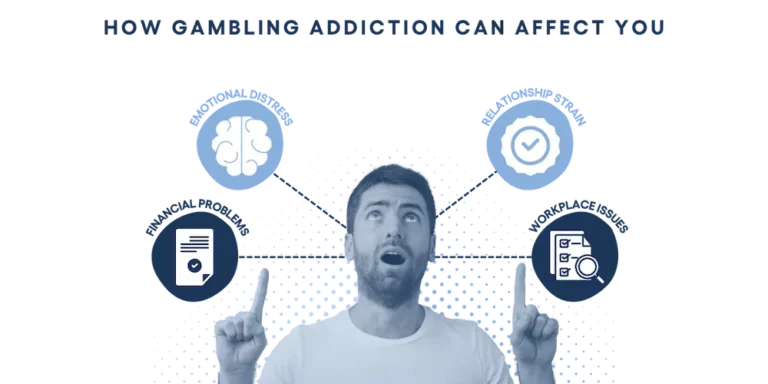
Gambling disorder isn’t just about money; it can impact nearly every part of someone’s life, from their mental health to their relationships and even their job. While the financial side tends to get the most attention, the emotional and social costs can be just as heavy.
Here are just a few of the ways problem gambling can show up:
In fact, a recent study from the Federal Reserve found that people who engage in legal online gambling tend to have lower credit scores, are more likely to miss mortgage payments, and face a higher risk of bankruptcy, showing just how far-reaching the consequences can be.
It’s clear that as access to gambling expands, so does the need for awareness, support, and effective treatment options.


Gambling disorder carries one of the lowest treatment-seeking rates of any behavioral health condition, driven by shame, denial, and a widespread belief that the problem can be self-corrected. In North Carolina, these barriers are compounded by a still-developing treatment infrastructure and the speed at which sports betting has drawn younger, less help-ready populations into harmful patterns. The figures below quantify how large the unmet need is and why connecting people to the right program in the Charlotte area matters more than ever.
| Barrier Preventing Gambling Treatment | Scale of the Unmet Need | Geographic Level |
|---|---|---|
| Proportion of people with a gambling problem who have ever sought help | Only 1 in 5 people with a gambling problem have sought any form of help [1] | Global |
| Share of individuals with problematic gambling who seek treatment in the US | Only about 10% of individuals with a gambling problem ever pursue treatment [2] | National |
| WHO-estimated share of the population seeking formal or informal gambling help | An estimated 0.14% of the population seeks formal or informal help for gambling [3] | Global |
| Sports bettors’ attitude toward accepting treatment when they call NC’s helpline | Sports bettors are less likely to accept treatment referrals compared to other callers [4] | North Carolina |
| Americans who underestimate the seriousness of gambling disorder | A majority of American adults downplay gambling disorder’s severity; those at the greatest risk are the most skeptical about treatment effectiveness [5] | National |
| Adolescents nationally living with gambling disorder; share at elevated risk | 3% to 8% have gambling disorder; 8% to 15% are at elevated risk; 1.1 million youth ages 12 to 17 exhibit disorder behaviors [6] | National |
| Youth who have gambled online despite legal age restrictions; share at risk for disorder | 10% of adolescents have gambled online; 26% of those are at risk for disorder, far exceeding adult rates [7] | Global |
| NC college students who perceived gambling as at least a minor issue on campus | More than 60% of undergraduates identified gambling as a campus concern, yet formal treatment engagement remains rare [8] | North Carolina |
| Share of those with problematic gambling who only sought help through Gamblers Anonymous or similar peer support | A large proportion rely solely on peer support with no formal clinical treatment, limiting long-term outcomes [1] | Global |
| People with 3 or more Adverse Childhood Experiences (ACEs) and elevated gambling risk | Three or more ACEs increase the likelihood of developing a gambling problem by 3 times, yet ACE screening is rarely part of gambling intake [6] | National |
Sources: [1] Canale et al. – Global Prevalence of Help-Seeking for Problem Gambling – PMC – https://pmc.ncbi.nlm.nih.gov/articles/PMC9796401/ [2] The Conversation – Millions of Americans Are Problem Gamblers, So Why Do So Few Seek Treatment? – https://theconversation.com/millions-of-americans-are-problem-gamblers-so-why-do-so-few-people-ever-seek-treatment-197861 [3] World Health Organization – Gambling Fact Sheet – https://www.who.int/news-room/fact-sheets/detail/gambling [4] NC Newsline – Calls to NC Gambling Helpline Rise as Sports Betting Increases (2025) – https://ncnewsline.com/2025/09/25/calls-to-north-carolinas-gambling-helpline-rise-as-sports-betting-increases/ [5] National Council on Problem Gambling – NGAGE 3.0 Survey (2024) – https://www.ncpgambling.org/training/ngage-survey/ngage-3/ [6] NC Problem Gambling Program – Youth Problem Gambling: What Communities Need to Know (2024) – https://morethanagame.nc.gov/wp-content/uploads/Youth-Problem-Gambling_-What-Communities-Need-to-Know-2024-1.pdf [7] Sparrow et al. – The Lancet Public Health Commission on Gambling, via Harvard Magazine (2025) – https://www.harvardmagazine.com/2025/03/harvard-research-gambling-public-health-crisis [8] East Carolina University GRPI – NC Baseline Study of College Student Gambling – https://gamblingresearch.ecu.edu/projects/
At Southeastern Recovery Center, we offer a holistic and compassionate approach to recovery. Our programs are designed to treat not just the gambling behavior itself, but the underlying emotional and psychological issues that drive it.
We begin with a thorough evaluation to determine the severity of your gambling addiction and identify any co-occurring disorders.
Our primary treatment modality is Cognitive Behavioral Therapy (CBT), which helps individuals recognize and change harmful thoughts and behaviors associated with gambling. Other therapeutic options may include Motivational Interviewing (MI), Dialectical Behavioral Therapy (DBT), Group Therapy, and Family Counseling.
We believe recovery is a long-term process. After completing a structured program, clients continue with relapse prevention strategies, peer support groups, and ongoing therapy.
Many clients benefit from financial education and planning to repair the damage caused by gambling-related debt.
In addition to treatment at Southeastern Recovery Center, North Carolina residents can access public and nonprofit resources, including:
North Carolina Problem Gambling Helpline: 1-877-718-5543 (available 24/7)
NC Department of Health and Human Services (DHHS): Provides state-funded treatment, prevention education, and research initiatives
Gamblers Anonymous (GA): Peer-led 12-step support meetings throughout North Carolina
Gam-Anon: Support for friends and families of individuals with gambling problems
Signs include increasing time or money spent on gambling, hiding gambling from others, chasing losses, and feeling restless when trying to stop.
Yes. With the right support and treatment plan, individuals can recover from gambling disorder and rebuild their lives.
While no medications are FDA-approved specifically for gambling addiction, some antidepressants or mood stabilizers may help with underlying issues such as anxiety or depression.
Absolutely. At Southeastern Recovery Center, we work with clients on a case-by-case basis to create affordable treatment plans. North Carolina also offers free or low-cost support through the DHHS Problem Gambling Program.
Yes. There are self-exclusion tools available for both casinos and online gambling apps. Our team can help guide you through setting these up.
Open communication is key. Encourage them to seek help, offer to attend a support meeting together, and avoid enabling their behavior. Gam-Anon is a great place for families to find their own support.
Gambling disorder is a clinically recognized addiction, classified by the American Psychiatric Association in the DSM-5 under behavioral addictions. It is the first and only non-substance behavioral condition to be formally categorized alongside substance use disorders, reflecting two decades of neuroscience research showing that gambling changes the brain in the same fundamental ways that drugs and alcohol do.
The willpower framing misunderstands how addiction works at a neurological level. When a person gambles, the brain releases dopamine through the same mesolimbic reward pathway activated by cocaine, alcohol, and opioids. With repeated gambling, the brain’s dopamine system becomes less sensitive over time, requiring more gambling to produce the same response. This is tolerance, and it is the same mechanism that drives dose escalation in substance addiction. The prefrontal cortex, which is responsible for impulse control and decision-making, shows measurably reduced activity in people with gambling disorder, just as it does in people with drug and alcohol addiction. Research has found that problem gamblers and drug addicts share the same genetic predispositions for impulsivity and reward-seeking behavior. The consequences of framing gambling addiction as a willpower failure include:
At Southeastern Recovery Center, gambling disorder is treated as the neurological condition it is, not as a moral or character failing.
Yes, and the data from North Carolina specifically is stark. Since legal mobile sports betting launched in March 2024, the state’s problem gambling landscape has changed in ways that are already showing up in treatment and crisis data.
North Carolina bettors have wagered more than $13.5 billion since the first betting apps went live, according to state data. Within the first six months of that launch, calls to the North Carolina Problem Gambling Helpline increased by 79 percent. Between 2021 and 2025, those calls more than tripled overall. The average age of people calling for help dropped from 43 to 38, reflecting a significant shift toward younger gamblers seeking treatment. Gamblers Anonymous meetings across North Carolina are reporting near-record attendance. Several patterns specific to mobile and sports betting explain why the problem has escalated so quickly:
If you live in North Carolina and your gambling started or escalated after sports betting became legal, you are not alone. The clinical community saw this coming, and treatment is available.
The two conditions occur together far more often than most people realize, and treating gambling addiction without addressing co-occurring substance use, or vice versa, significantly reduces the likelihood of lasting recovery from either.
Research shows that 94 percent of people with gambling problems have at least one co-occurring mental health or addiction disorder, including alcohol and drug dependence. People with gambling disorder have 5.5 times the risk of a substance use disorder compared to the general population. The relationship runs in multiple directions. Some people use alcohol or drugs to manage the anxiety and emotional distress that gambling creates, or to blunt the shame of significant losses. Others gamble more when they are using substances because impaired judgment increases risk-taking and makes it harder to stop. Many people find that both behaviors serve the same function: numbing emotional pain, chasing stimulation, or escaping stress. The specific combinations that appear most frequently in clinical settings include:
At Southeastern Recovery Center, gambling disorder treatment addresses any co-occurring substance use as part of a unified dual diagnosis plan, because treating one while ignoring the other is one of the most reliable pathways back to both.
Gambling disorder has one of the highest rates of suicidal ideation of any addiction. A 2023 meta-analysis found that nearly one in three people with gambling disorder has experienced suicidal ideation. Research shows that one in six people addicted to gambling will attempt suicide.
The mechanisms are not difficult to understand. By the time many people with gambling disorder seek help, they may have lost significant amounts of money, accumulated serious debt, damaged or destroyed relationships, and spent months or years hiding the full scope of the problem from everyone around them. The financial consequences of gambling disorder are among the most severe of any addiction. Nearly 30 percent of sports bettors report going into debt because of gambling, and states that have legalized sports betting have seen measurable increases in bankruptcies and decreases in credit scores among residents. The psychological weight of those consequences, combined with the neurological effects of chronic gambling on the brain’s mood regulation systems, creates conditions that strongly predispose people to depression and, in serious cases, suicidal crisis. Several specific factors amplify this risk:
If you or someone you love is experiencing thoughts of suicide alongside a gambling problem, please reach out immediately. At Southeastern Recovery Center, we assess for suicidal ideation and depression as part of the clinical intake process, because gambling disorder does not arrive alone.
Gambling activates the brain’s mesolimbic dopamine reward system, the same pathway that responds to cocaine, heroin, and alcohol. The brain does not distinguish between chemical substances and behavioral stimuli when it comes to generating dopamine responses, which is exactly why gambling disorder is classified as a behavioral addiction rather than simply a bad habit.
What makes gambling neurologically distinctive is that the dopamine release is not limited to winning. Research shows that the anticipation of a potential win triggers as much or more dopamine as the win itself, and that near-misses, including a slot that almost lines up or a bet that almost covers, produce a dopamine spike that functions like a reward even though the outcome was a loss. Gambling products are specifically designed to maximize these near-miss events. Over time, the brain’s dopamine system adapts to chronic gambling stimulation in several ways that make stopping progressively more difficult:
Understanding this is not about excusing the behavior. It is about understanding why effective treatment requires neurological and behavioral intervention, not simply motivation or discipline. At Southeastern Recovery Center, we build treatment around what is actually happening in the brain, not around the assumption that wanting to stop is enough.
The financial consequences of gambling disorder are often the most immediately visible and most destabilizing aspect of the condition, and they require their own attention as part of a comprehensive recovery plan.
Gambling disorder is uniquely destructive financially because chasing losses is a defining feature of the disorder, not a side effect of it. Every significant loss creates a psychological and neurological drive to keep gambling in order to win the money back, which produces a cycle that systematically accelerates financial harm rather than reversing it. The financial profile of untreated gambling disorder includes:
Treatment for gambling disorder addresses the financial dimension in several ways. Therapeutic work includes identifying the emotional triggers that drive chasing behavior and building practical strategies for managing financial stress without gambling. For clients with significant financial consequences, case management can help coordinate connection to financial counseling or legal resources as part of the broader recovery plan. Family therapy helps address the financial trust damage that gambling disorder frequently creates between the person in recovery and the family members who have been affected.
At Southeastern Recovery Center, the financial wreckage of gambling disorder is treated as a real clinical concern that affects recovery outcomes, not as a separate problem to figure out after treatment is done.
The underlying disorder is the same, but the specific features of online and sports betting create conditions that accelerate addiction development, increase severity, and make certain aspects of treatment more challenging than traditional casino gambling.
Clinically, gambling disorder is gambling disorder regardless of the format. The brain mechanisms, the behavioral patterns, and the treatment approaches are consistent across gambling types. What differs with mobile sports betting and online gambling is the environment in which the addiction develops and operates. Several features of online and sports betting are clinically relevant:
At Southeastern Recovery Center, treatment planning for gambling disorder accounts for the specific format of gambling that drove the addiction, because the cues, triggers, and behavioral patterns associated with sports betting are meaningfully different from those associated with a weekly poker game.
Cognitive Behavioral Therapy is the most extensively researched and consistently effective treatment for gambling disorder. Meta-analyses show that 65 to 82 percent of people who complete CBT for gambling demonstrate greater reductions in gambling behavior than those who receive no treatment, and CBT shows stronger evidence than any other psychological approach for this condition.
CBT for gambling disorder works by targeting both the cognitive distortions that sustain gambling behavior and the behavioral patterns that maintain it. Common cognitive distortions in gambling disorder include the gambler’s fallacy, believing that past outcomes influence future random results, the illusion of control, believing that skill or strategy can affect purely chance-based outcomes, and chasing logic, the belief that continued gambling will eventually recover losses. These thought patterns are not irrational character flaws. They are predictable products of how the gambling-affected brain processes probability and risk. CBT systematically identifies and restructures them. Beyond CBT, several additional modalities contribute meaningfully to gambling disorder treatment:
At Southeastern Recovery Center, gambling disorder treatment integrates CBT, Motivational Interviewing, trauma-focused care, and group therapy within the same dual diagnosis framework we use for substance use disorders, because the clinical overlap between gambling addiction and substance addiction warrants the same level of structured, evidence-based care.
Getting started takes one phone call, and most clients are able to begin treatment within 24 to 48 hours of that first conversation.
We understand that reaching out for gambling addiction treatment often involves a significant amount of shame, fear about financial disclosure, and uncertainty about what treatment actually looks like. Our admissions process is designed to remove those barriers as much as possible:
Gambling disorder is one of the most treatable addictions when care is comprehensive and addresses the full scope of what the disorder affects, including mood, relationships, and the underlying patterns that drove the behavior in the first place. At Southeastern Recovery Center, that is exactly the kind of care we provide.

We know that gambling addiction can feel isolating, but you are not alone. Our experienced team understands the unique landscape of gambling in North Carolina and is committed to helping clients find lasting recovery.
Here’s what sets us apart:
Licensed mental health professionals and addiction specialists
Individualized treatment plans tailored to your specific needs
Safe, supportive, and stigma-free environment
Continuum of care from detox (if needed) to aftercare
Guidance in financial recovery and rebuilding relationships
Gambling addiction doesn’t have to control your life. With the right support, you can break the cycle and find freedom. Southeastern Recovery Center is here to help you or your loved one every step of the way.
Contact us today to schedule a confidential consultation or learn more about our comprehensive gambling addiction treatment programs.