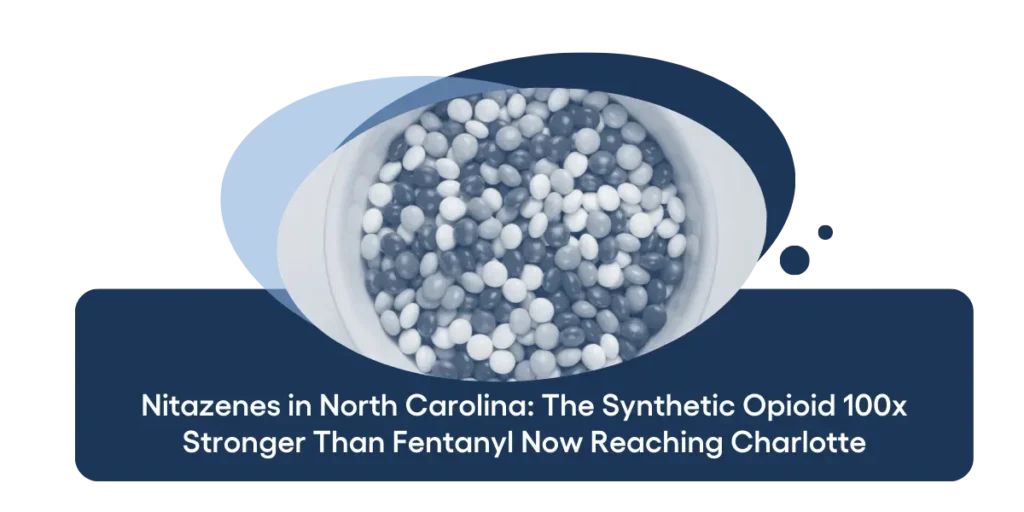
Even while North Carolina and America at large are still grappling with the opioid epidemic, new synthetic opioids like nitazenes are making addiction hard to fight. In particular, Nitazene is a synthetic drug stated to be 100 times stronger than fentanyl and is now starting to reach our Charlotte, NC community.
At Southeastern Recovery Center, we keep up with the latest developments in illegal drugs in order to spread awareness for the new ways that addiction can harm our communities. Even in the case of a more potent and deadly substance such as nitazenes, spreading awareness about the substance and the dangers it presents is the first step in preventing the synthetic opioid causing more widespread harm in North Carolina.
Article TL;DR: Nitazenes are a synthetic opioid that is stronger than fentanyl and gradually becoming more circulated across North Carolina. Like most drugs, nitazenes will be at their most dangerous the less individuals know about them.
Article Preview:
What Are Nitazenes? Nitazenes are synthetic opioids that are stated to be several times stronger than fentanyl and morphine.
Are Nitazenes in North Carolina? Yes, nitazenes are in North Carolina.
How Do Nitazenes Compare to Fentanyl? Nitazenes are anywhere from 40 times to 100 times as strong as fentanyl, depending on their chemical composition.
Can Narcan Reverse a Nitazene Overdose? Yes, Narcan can reverse a nitazene overdose.
What Are the Signs of a Nitazene Overdose? Signs of nitazene overdose include loss of consciousness, inability to talk, and vomiting.
Why Are Nitazenes So Dangerous? Nitazenes are so dangerous because there in a controlled substance that has a wildly varying chemical composition depending on the underground lab they were manufactured in.
FAQs about Nitazenes in North Carolina: The Synthetic Opioid 100x Stronger Than Fentanyl Now Reaching Charlotte. Learn answers to frequently asked questions about nitazenes in NC.
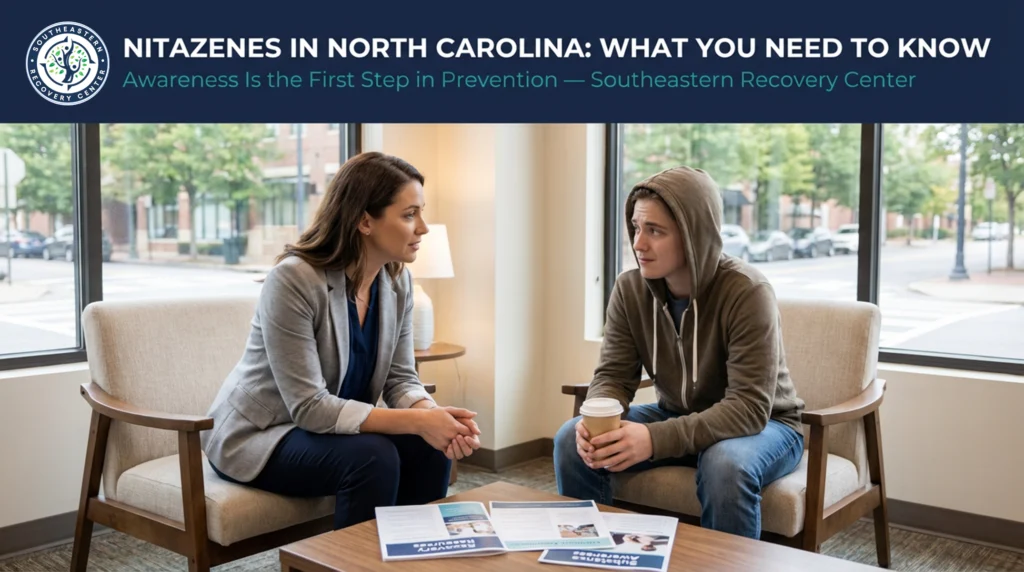
What are Nitazenes?
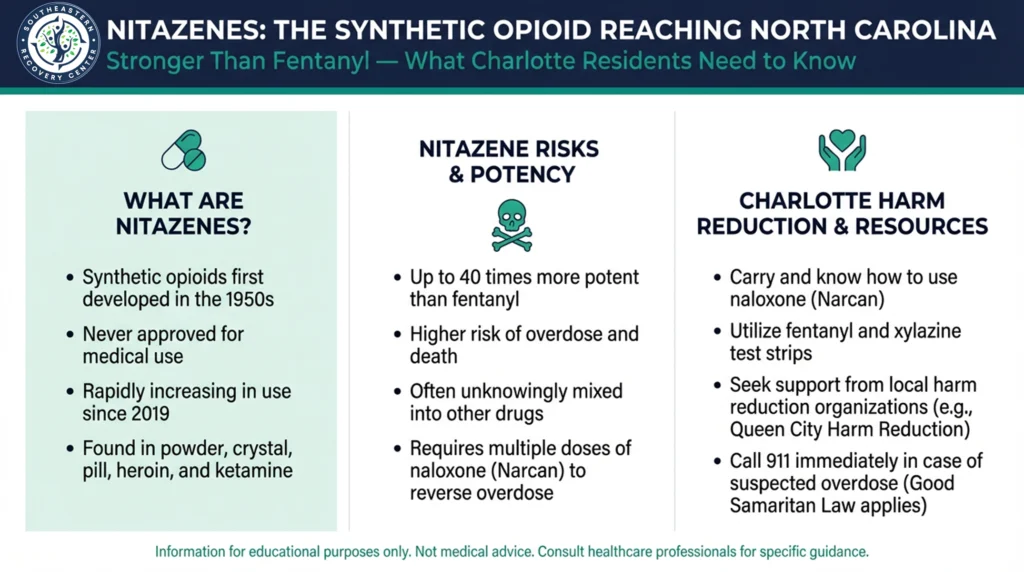
Nitazenes are a class of synthetic opioids that were initially developed in the 1950s to be an alternative to morphine, though they were never approved for medical use. Since 2019, nitazenes have been rapidly increasing in usage across the world. In 2022, synthetic opioids like nitazenes were responsible for 68% of all overdose deaths in the United States.
Nitazenes are also noted to have a potency up to 500 times that of morphine. Nitazenes may be found in white powder form, as a solid crystal, or as a brown or yellow powder. They are also increasingly being found in tablets, heroin, ketamine, and even synthetic cannabinoids. This makes it difficult for drug users to know when they’re being exposed to nitazenes.
At Southeastern Recovery Center, our treatment facility in Mecklenburg County is often visited by individuals who are blindsided by the rapid spreading of new drugs. Synthetic opioids like Nitazenes thrive in an environment where their usage goes unnoticed and their dangers are underreported. That’s why we’re doing our part now to spread awareness for this drug that overshadows the already-dangerous fentanyl.
Are Nitazenes in North Carolina?
Yes, nitazenes are currently in North Carolina, though the prevalence of their circulation is unknown. In 2023, the Washington Post covered how North Carolinian Samanatha Ross overdosed on nitazenes.
Additionally, Dr. Nabarun Dasgupta, a scientist at the University of North Carolina’s Gillings School of Global Public Health, said that expects nitazenes and nitazene analogues to fill gaps in the drug market as fentanyl supply drops. He’s basing this on his research as a professional who tracks nitazenes and other novel drugs within the U.S.
The fact that the presence of nitazenes in our community is still largely unknown makes it even more dangerous, whether people take the substance intentionally or unintentionally.
How Do Nitazenes Compare to Fentanyl?
Nitazenes and fentanyl are alike in that they are both synthetic opioids which means that both substances are manufactured in underground drug laboratories. However, the two substances have different chemical structures, which contributes to the additional dangers of nitazenes over fentanyl.
While the exact potency of nitazenes compared to fentanyl will vary depending on the chemical formulation, the stats are dire:
- Nitazenes are 500 to 800 times more potent than morphine
- Nitazenes are 40 to 100 times more potent than fentanyl
- Nitazenes can come in liquid, pill, or powder form.
The fact that nitazenes can vary wildly contributes to the danger factor. Individuals may underestimate nitazenes overall because of their experience with one particular formulation, only to encounter a more potent form of nitazenes, which could result in an overdose.
Can Narcan Reverse a Nitazene Overdose?
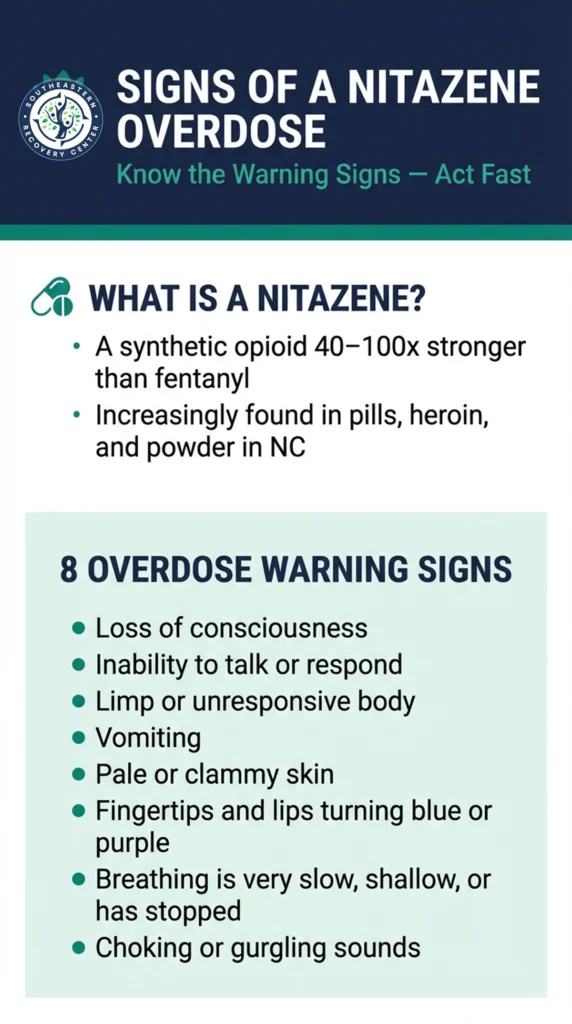
Yes, Narcan (naloxone) is currently known to function in order to reverse a nitazene overdose. However, studies have shown that the high potency of nitazenes means that more and higher doses of Narcan may be needed to reverse an overdose. Individuals who are suffering from a nitazene overdose will need to be seen by emergency medical professionals as soon as possible so that they can determine the required dosage of Narcan needed.
What Are the Signs of a Nitazene Overdose?
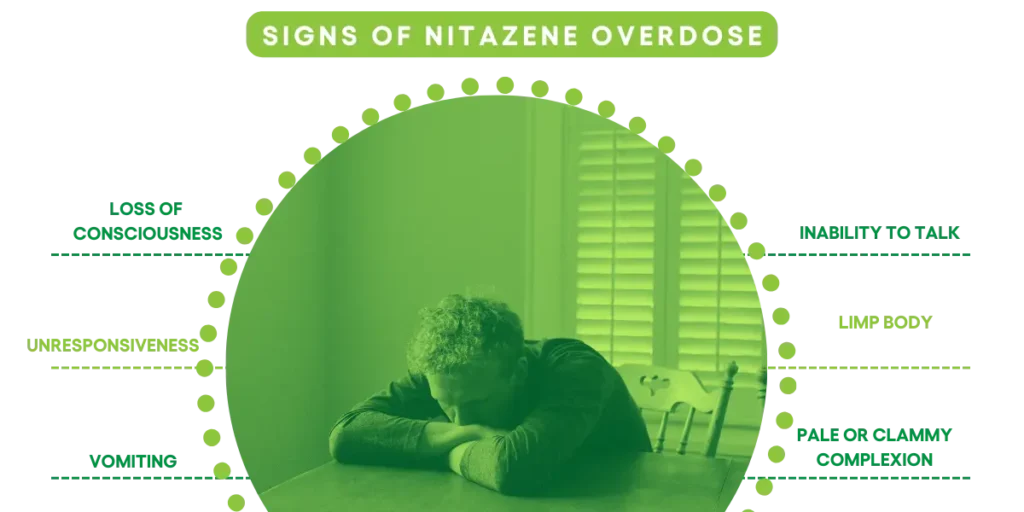
Because nitazenes are synthetic opioids, the signs of the nitazene overdose overlap with the sides of an opioid overdose. These nitazene overdose signs include:
- Loss of consciousness
- Inability to talk
- Unresponsiveness
- Limp body
- Vomiting
- Pale or clammy complexion
- Fingertips and lips turned blue or purple
- Slow or erratic heartbeat
Why Are Nitazenes So Dangerous?
There are a couple of overlapping factors that contribute to the danger of nitazenes.
- Nitazenes are an uncontrolled, illegally manufactured substance. This means that the chemical formulation varies wildly. These changes in the chemical makeup of nitazenes potency when compared to fentanyl or morphine can be dozens or hundreds of times stronger, making individuals more likely to overdose.
- Nitazenes are potent. Even the weaker formulations of nitazenes are still more powerful than fentanyl or morphine, which makes them more likely to cause adverse effects in users.
- Nitazenes come in many different forms and are combined with other illicit drugs. This means that individuals may be exposed to this potent synthetic opioid without even being aware. Not only does this make them more likely to overdose, but it also means that any individuals around them may be unaware that an individual is experiencing nitazene overdose.
- Nitazenes are unknown. This means that the general public in North Carolina is unaware that these drugs are in circulation, or that an overdose on nitazenes can be treated with Narcan.
Nitazenes are dangerous, but spreading awareness is one of the most powerful steps we can take to reduce the deadliness of the synthetic drug in Charlotte, North Carolina and across our state. At Southeastern Recovery Center, we’re prepared to help individuals suffering from opioid addiction get the help they need, including facilitating their placement into detox facilities to overcome synthetic opioid withdrawal symptoms.
If you or a loved one are currently struggling with addiction to synthetic opioids like nitazenes or fentanyl, please know that help is available. We create personalized drug addiction plans that help individuals address the underlying causes of their addiction, come up with healthy coping mechanisms, and receive aftercare to help them avoid relapsing after recovery.
FAQs about Nitazenes in North Carolina: The Synthetic Opioid 100x Stronger Than Fentanyl Now Reaching Charlotte
What are nitazenes?
Nitazenes are synthetic opioids like fentanyl, though they are several times stronger than fentanyl and morphine.
How strong are nitazenes?
Nitazenes are anywhere from 500 to 800 times more potent than morphine, and 50 to 100 times more potent than fentanyl.
Can nitazene overdose be treated?
Yes, nitazene overdose can be treated with the use of Narcan.
What are some signs of a nitazene overdose?
Signs of nitazene overdose include loss of consciousness, vomiting, and a limp body.
Sources:
Inter-American Drug Abuse Control Commission. INFORMATION BULLETIN the EMERGENCE of NITAZENES in the AMERICAS. https://www.oas.org/ext/DesktopModules/MVC/OASDnnModules/Views/Item/Download.aspx?type=1&id=1045&lang=1. 2024.
“What Are Fentanyl and Nitazenes? Explaining the Rise and Risks of Potent Synthetic Opioids – Alcohol and Drug Foundation.” Adf.org.au, 2025, adf.org.au/insights/fentanyl-and-nitazenes.
Schwarz, Evan S, et al. “Nitazenes: An Old Drug Class Causing New Problems.” Missouri Medicine, vol. 122, no. 4, July 2025, p. 329, pmc.ncbi.nlm.nih.gov/articles/PMC12331301.
Ovalle, David. “On the Streets, Opioids Sometimes More Potent than Fentanyl: Nitazenes.” The Washington Post, 10 Dec. 2023, www.washingtonpost.com/health/2023/12/10/nitazenes-opioid-stronger-than-fentanyl.
Greene, Connor. “What Comes after Fentanyl? In a “Period of Hyper-Change,” a New Opioid Is Emerging.” TIME, Time, 16 Sept. 2025, time.com/7317460/nitazenes-fentanyl-opioid-crisis-drugs.
Niesel, David. “Even Worse than Fentanyl.” Medical Discovery News (Mdnews), 7 May 2024, www.utmb.edu/mdnews/podcast/episode/even-worse-than-fentanyl.
Dahan, Albert, et al. “Fact vs. Fiction: Naloxone in the Treatment of Opioid-Induced Respiratory Depression in the Current Era of Synthetic Opioids.” Frontiers in Public Health, vol. 12, 28 Feb. 2024, https://doi.org/10.3389/fpubh.2024.1346109.