
Trucking and logistics professionals that want to remain road-ready must ensure that they’re compliant with all rules and regulations set by the Department of Transportation (DOT). This includes taking the appropriate steps to receive treatment in the case of drug and alcohol regulation violations. Substance abuse professionals (SAP) are medical professionals that evaluate employees that are found to have violated DOT drug and alcohol regulations.
At Southeastern Recovery Center, we often help individuals looking to be connected with DOT SAP evaluations around Charlotte (where our office is located). These substance abuse professionals make personalized recommendations concerning education, treatment, and aftercare for individuals, open to ensure effective delivery of CDL driver drug treatment in NC.
Below, we’ll provide a primer for drivers looking to maintain employment and CDL licensure despite drug and alcohol usage.
Article TL;DR: The Department of Transportation is willing to work with truck drivers who are found to have violated drug and alcohol regulations. Still, the only way a CDL driver can resume driving is to complete a DOT SAP evaluation.
Article Preview:
What Are the Rules for CDL Drivers When It Comes to Drug and Alcohol Usage? CDL drivers that violate the drug and alcohol use rules outlined by the Department of Transportation have to go through DOT SAP evaluations in order to resume driving.
What Are DOT SAP Evaluations? DOT SAP evaluations are evaluations conducted by substance abuse professionals to ensure that drivers have gotten a handle on their use of drugs or alcohol.
What Goes Into a SAP Evaluation? SAP evaluations include initial assessments, testing, treatment planning, follow-up evaluations, the return-to-duty process, and aftercare recommendations.
The Importance of DOT SAP Evaluations in Charlotte (and North Carolina at Large). Charlotte, North Carolina is a major hub for truck drivers, which means the mental health of drivers on the road can impact all of us.
FAQs about Trucking & Logistics: Staying Road-Ready with DOT-Compliant Treatment in NC. Learn answers to frequently asked questions about CDL drivers remaining DOT-compliant.
What Are the Rules for CDL Drivers When It Comes to Drug and Alcohol Usage?
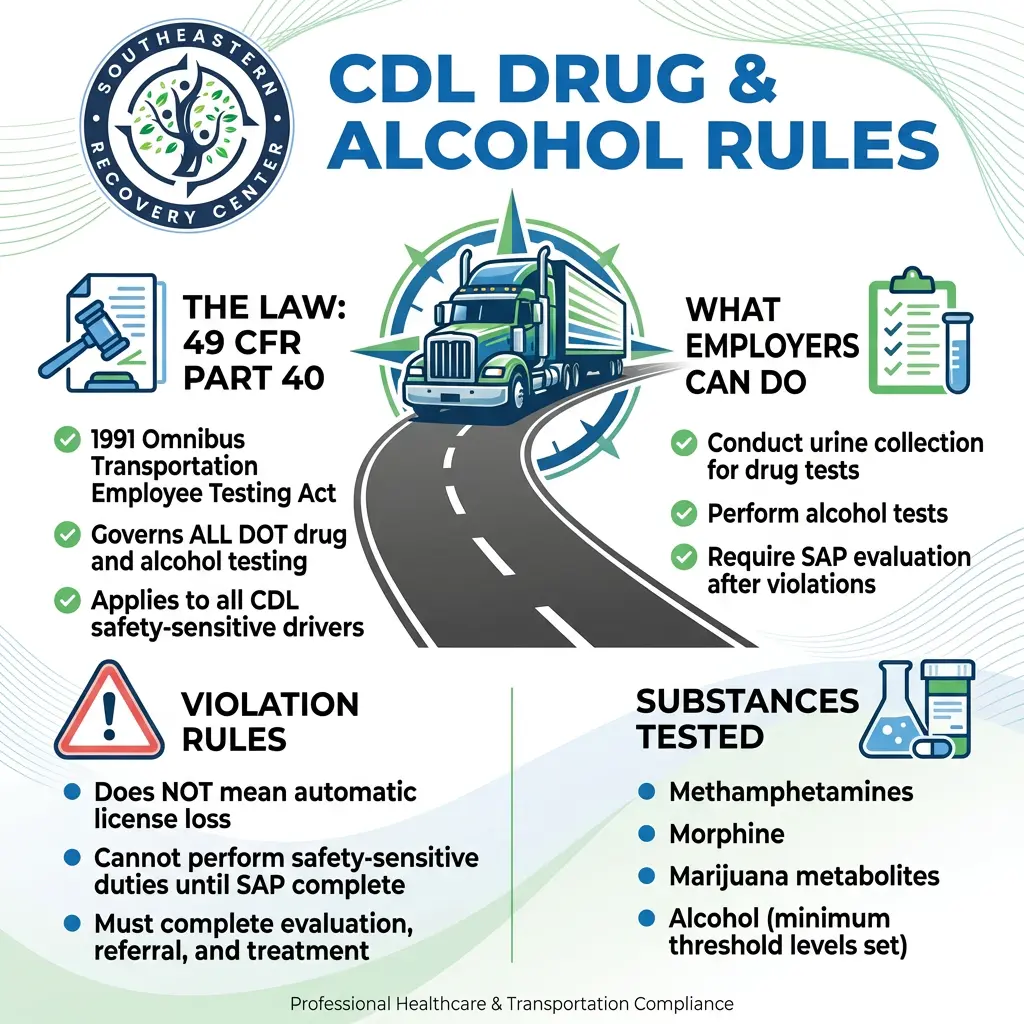
Largely, the transportation industry aims to be drug and alcohol free. In accordance with this goal, DOT agencies implemented drug and alcohol testing for transportation employees via the 1991 Omnibus Transportation Employee Testing Act. 49 CFR Part 40 (sometimes shortened to Part 40) is the Department of Transportation’s regulations for how states should conduct drug and alcohol testing.
It’s important to note that CDL drivers do not automatically lose their licenses due to a violation of the drug and alcohol guidelines.
49 CFR Part 40 includes rules for drug and alcohol usage include but are not limited to:
- Permission for employers to conduct urine collection for drug tests
- Permission for employers to perform alcohol tests
- Employees who have violated DOT drug and alcohol regulations to require SAP evaluation. As outlined: “you cannot again perform any DOT safety-sensitive duties for any employer until and unless you complete the SAP evaluation, referral, and education/treatment process set forth in this subpart and in applicable DOT agency regulations.”
49 CFR Part 40 also sets guidelines for the minimum amounts of alcohol and various drugs such as methamphetamines, morphine, and Marijuana metabolites to determine that a truck driver is in violation.
What are DOT SAP evaluations?
DOT SAP evaluations are the required steps that truck drivers that are found to have violated the alcohol and drug use guidelines have to go through in order to resume driving. These evaluations involve a meeting with a medical professional who will help create a personalized plan for recovery.
These substance abuse professionals are responsible for helping drivers address the underlying factors that might have led them to drug and alcohol abuse. In that way, they’re not at all unlike our own team at Southeastern Recovery Center, doing our best to address underlying issues in our patients suffering from substance use disorders.
What Goes Into a SAP Evaluation?
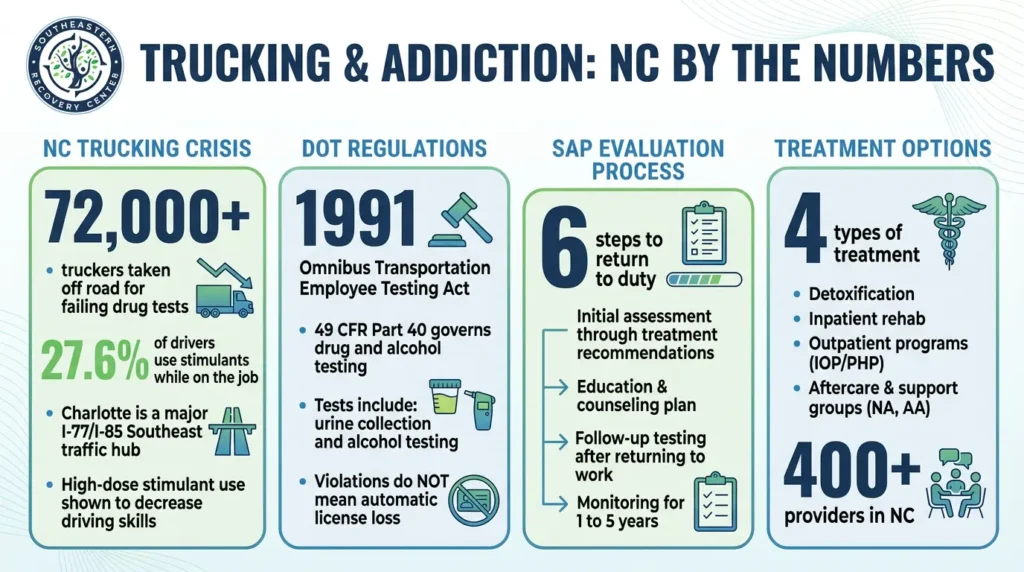
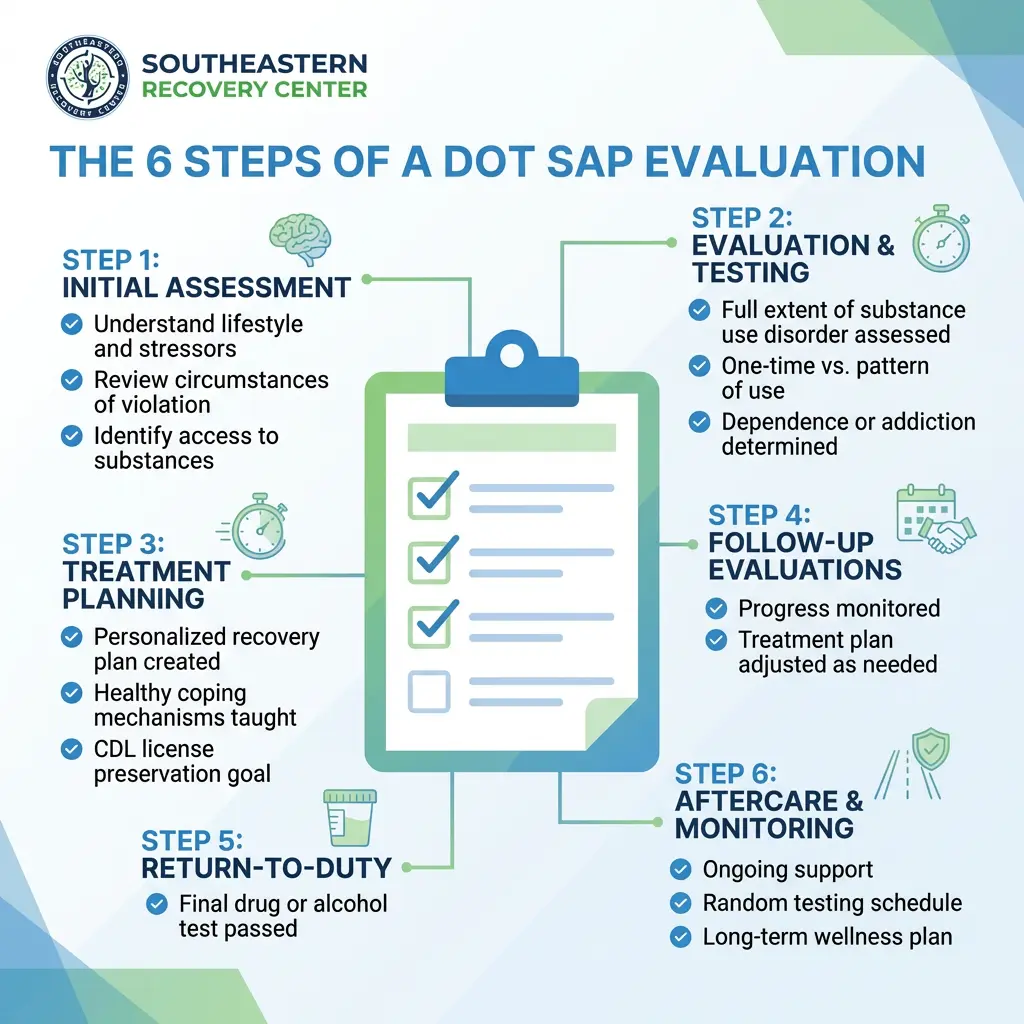
DOT SAP evaluations follow a fairly simple six step process:
1. Initial assessment. This is when the substance abuse professional that you’ll be working with takes the time to understand the initial factors of your drug or alcohol violation. Think in terms of your lifestyle, stressors, and general access to the substance that led to your violation.
2. Evaluation and testing. This is when the SAP digs deeper, looking to learn the full extent of your substance use disorder. Was this a one-time violation, or a pattern? Has dependence or addiction on drugs and alcohol set in?
3. Treatment planning. This is when your substance abuse professional will create the actual personalized treatment plan to help ensure that you can get back to working without losing your CDL license. This will likely include coping mechanisms that teach healthy alternatives to usage of drugs or alcohol.
4. Follow-up evaluations. Follow-up evaluations help your SAP check your progress and ensure that the treatment plan is working as intended.
5. Return-to-duty process. Once a CDL driver is determined to have completed their drug treatment, the substance abuse professional will proceed with the return to duty process. This includes a final drug or alcohol test to help verify the curbing of the substance abuse habit.
6. Aftercare recommendations. Even after a CDL driver has returned to work, the SAP may offer aftercare recommendations in order to help ensure continued improved behavior over time. At Southeastern Recovery Center, we often connect our patients with sober living options and group therapy to help build social connections with individuals who have experienced the same challenges they are.
The process of drug and alcohol addiction for CDL drivers will vary from person to person, but the broad strokes are well-formulated and statistically proven to give drivers the best possible chance for recovery.
The importance of DOT SAP evaluations in Charlotte (and North Carolina at large)
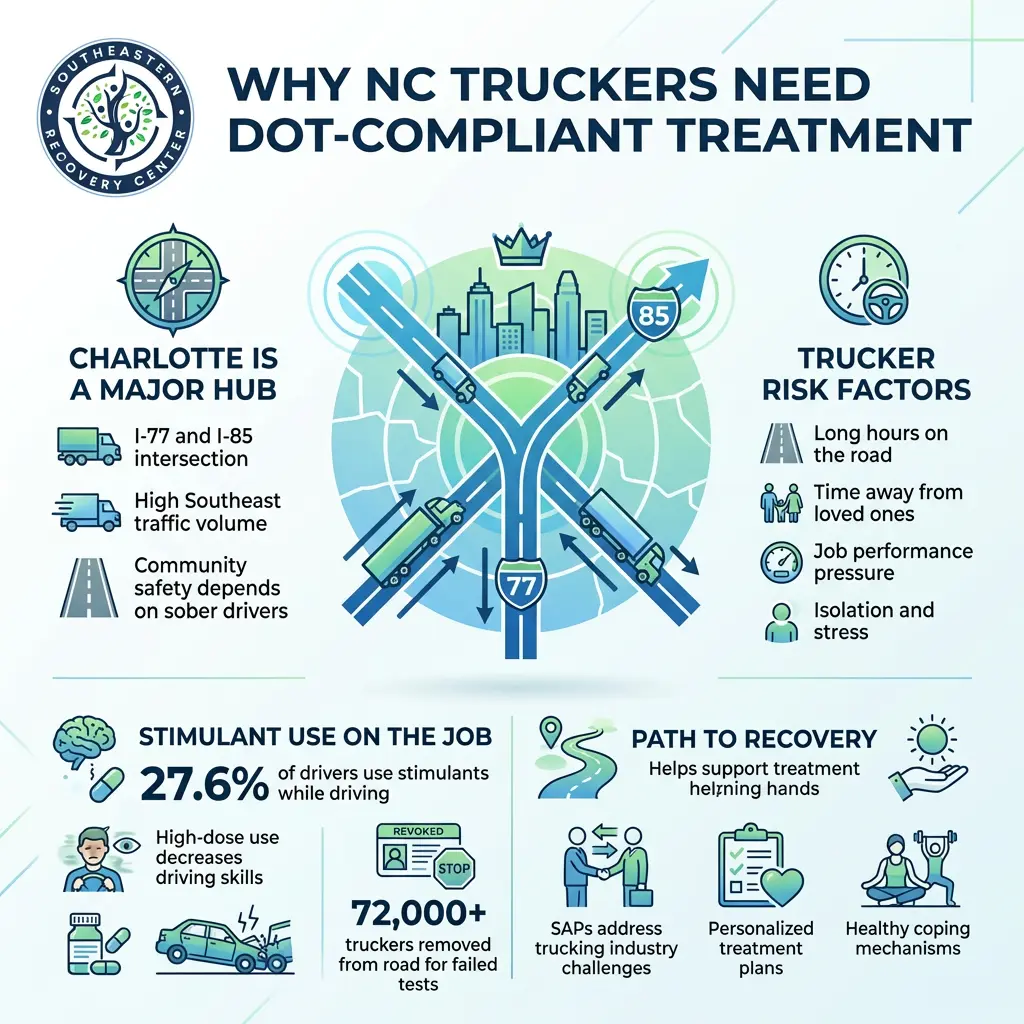
Charlotte, North Carolina is a I-77/I-85 hub, which means we see a high amount of traffic traveling throughout the Southeast. Naturally, it’s in our best interest for these CDL truck drivers to be sober and attentive while on our roads. But when we look at the data:
- More than 72,000 truckers have been taken off the road due to failing strict drug tests.
- Additionally, an estimated 27.6% of drivers use drugs such as stimulants while on the job, despite chronic and high-dose consumption being shown to “decrease driving skills.”
Our community’s drivers to be sober. This means connecting drivers with the care that they need to learn healthier coping mechanisms rather than turning to alcohol or drugs in order to deal with stress or while seeking higher job performance.
Long hours on the road and time away from loved ones can make it difficult for drivers to resist the temptation of drugs, but SAPs in North Carolina are equipped to address all of the unique challenges in the trucking and logistics industry.
FAQs about Trucking & Logistics: Staying Road-Ready with DOT-Compliant Treatment in NC
Are truckers immediately fired if they do drugs or alcohol?
No, the Department of Transportation does not require that truckers be immediately fired if they do drugs or alcohol. Instead, the DOT lays out a process to follow that allows truckers to get the help they need to recover from drug or alcohol addiction.
What are DOT SAP evaluations?
DOT SAP evaluations are evaluations conducted by a substance abuse professional as required by the Department of Transportation. These evaluations are a necessary step in a driver resuming driving after being found to have violated alcohol and drug use guidelines.
What are the steps of a DOT SAP evaluation?
The steps of a DOT SAP evaluations include initial assessment, evaluation and testing, treatment planning, follow-up evaluations, the return-to-duty process, and aftercare recommendations.
Can a CDL driver return to work without receiving drug treatment?
No, CDL drivers are required to complete drug treatment before they’ll be cleared to return to driving.
Sources:
“Federal Register :: Request Access.” Unblock.federalregister.gov, www.ecfr.gov/current/title-49/subtitle-A/part-40.
Fickenscher, Lisa. “Supply Chain Stalled by 72,000 Truckers Who Failed Strict Drug Tests.” New York Post, 7 Nov. 2021, nypost.com/2021/11/07/supply-chain-stalled-by-72000-truckers-who-failed-drug-tests/.
DINI, G., et al. “Psychoactive Drug Consumption among Truck-Drivers: A Systematic Review of the Literature with Meta-Analysis and Meta-Regression.” Journal of Preventive Medicine and Hygiene, vol. 60, no. 2, 28 June 2019, pp. E124–E139, www.ncbi.nlm.nih.gov/pmc/articles/PMC6614564/, https://doi.org/10.15167/2421-4248/jpmh2019.60.2.1245.