For veterans and first responders, receiving specialized dual diagnosis care in North Carolina can be a hassle. Dual diagnosis care is treatment that tackles both substance use disorders as well as co-occurring mental health disorders simultaneously. This means treating individuals for drug and alcohol addiction as well as disorders such as anxiety, PTSD, or depression.
Treating just one of these conditions on their own is difficult enough. But being able to tackle both simultaneously, especially in a state like North Carolina which has spotty access to rehab facilities in general, can be a challenge.
But at Southeastern Recovery Center, we excel in providing dual diagnosis care for veterans and first responders. Part of our ability to provide personalized care comes from our science-backed methods of tackling mental health disorders and their connection to substance use disorder. At our Concord, North Carolina location, serving the Charlotte area, we make sure that all individuals are placed on the path to recovery.
Summary: Veterans and first responders are exposed to extreme situations, which makes them more likely to develop mental health disorders such as PTSD and anxiety, in addition to substance use disorders. Very few facilities are equipped to handle specialized dual diagnosis treatment, which is a negative for everyone.
Article Preview:
What is a Dual Diagnosis? A dual diagnosis is when an individual is suffering from a mental health disorder and a substance use disorder simultaneously.
Why Do Veterans and First Responders Need Dual Diagnosis Treatment? Exposure to extreme circumstances make veterans and first responders more likely to develop dual diagnosis.
Why is Dual Diagnosis Treatment Relevant in Charlotte (and North Carolina)? Veterans and first responders in North Carolina need support, and dual diagnosis treatment should be available for everyone.
What Types of Mental Health Disorders Occur Simultaneously as Substance Use Disorders? Anxiety, PTSD, and depression are among a few mental health disorders that occur simultaneously as substance use disorders.
Are There Any Addictive Substances That Are Known to Cause Mental Health Disorders? MDMA a.k.a. ecstasy can cause depression and anxiety.
How Do I Know if I’m Going to Receive High-Quality Dual Diagnosis Treatment? A rehab facility that is accredited and tackles mental health disorders as well as substance use disorders may be able to provide dual diagnosis treatment.
FAQs Veterans and First Responders: Specialized Dual Diagnosis Care in North Carolina. Get answers to frequently asked questions about dual diagnosis care for veterans and first responders.
What is a Dual Diagnosis?
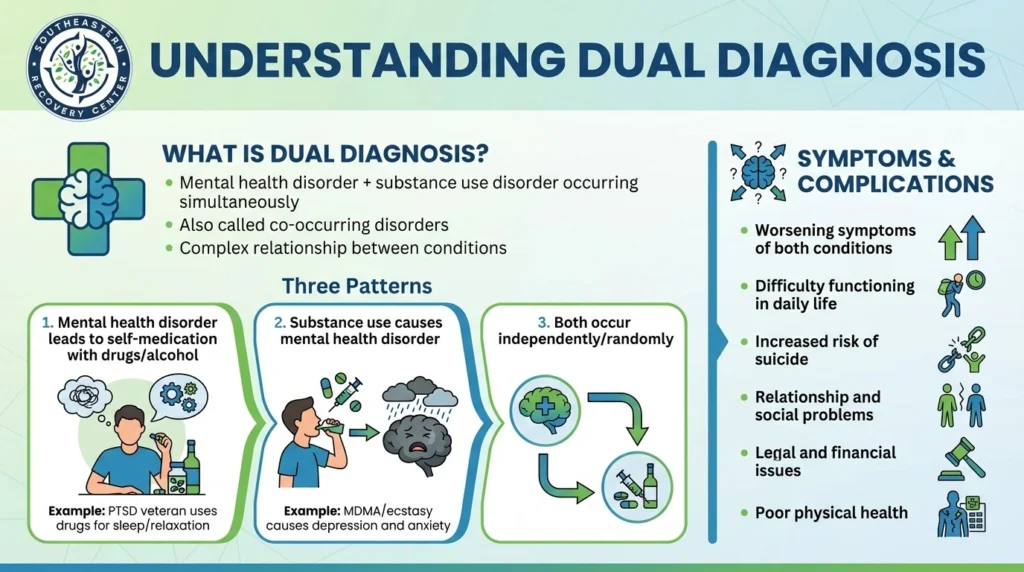
A dual diagnosis is when an individual is determined to be experiencing a mental health disorder at the same time they’re experiencing a substance use disorder. Dual diagnosis is also sometimes referred to as co-occurring disorder.
Substance use disorders and mental health disorders have a relationship to each other that varies from person to person. In some cases, mental health disorders can be a major part of the underlying conditions that can lead an individual to self medicate with drugs or alcohol, which in turn can lead to the development of a substance use disorder. For example, a dual diagnosis for PTSD may involve a veteran suffering from the mental health disorder seeking out drugs to help with relaxation or sleep. In other cases, use of substances might result in a mental health disorder development. Other times, the two can occur completely randomly.
The complicated link between mental health disorders and substance use disorders contribute to the difficulty veterans and first responders have with finding high quality dual diagnosis treatment. A facility has to be prepared to deal with both types of disorders in order to properly treat patients suffering from dual diagnosis.
Why Do Veterans and First Responders Need Dual Diagnosis Treatment?
Veterans and first responders need dual diagnosis treatment because of the extreme scenarios that they find themselves in, making them more at risk of mental health disorders such as PTSD, anxiety, and depression, which can in turn directly or indirectly contribute to them developing substance use disorders as well.
The U.S. Department of Veterans Affairs shares information about this directly:
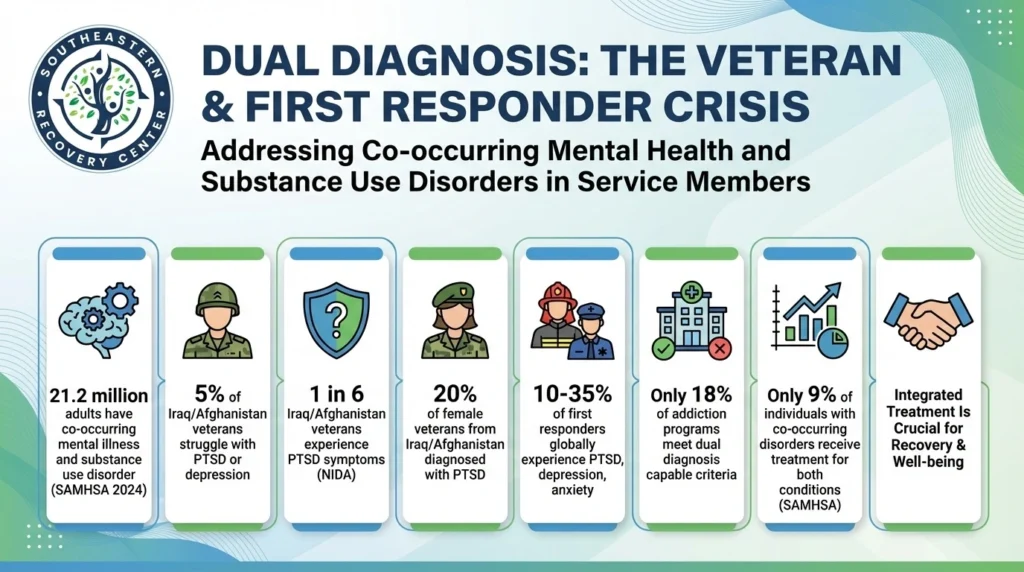
- Of service members returning from Iraq or Afghanistan, 5 percent struggle with PTSD or depression, according to the Mental Health Services Administration
- According to the National Institute on Drug Abuse (NIDA), about 1 in 6 Veterans who served in Iraq and Afghanistan experience symptoms of PTSD.
- According to the VA’s National Center for PTSD, almost 20 percent of female Veterans who served in Iraq and Afghanistan have been diagnosed with PTSD.
First responders are in similarly severe situations. First responders include professions such as firefighters, paramedics, and police officers. These individuals respond to individuals whose lives are directly in danger, exposing them to high stress situations that can linger in the mind.
Globally it is estimated that 10% to 35% of first responders experience mental disorders such as PTSD, depression, anxiety.
Why is Dual Diagnosis Treatment of Veterans and First Responders Relevant in Charlotte (and North Carolina)?
Dual diagnosis treatment for veterans and first responders is important in North Carolina because these are individuals who serve or have served not only our state, but our country. The fact that they’ve developed a dual diagnosis as a result means that the dynamic between them and us is shifted. Rather than veterans and first responders serving our community, our community now has to answer the call to help serve them.
According to SAMHSA’s 2024 National Survey on Drug Use and Health (NSDUH), approximately 21.2 million adults had a co-occurring mental illness and substance use disorder, which shows how prevalent the condition is (even if North Carolinians may not realize it).
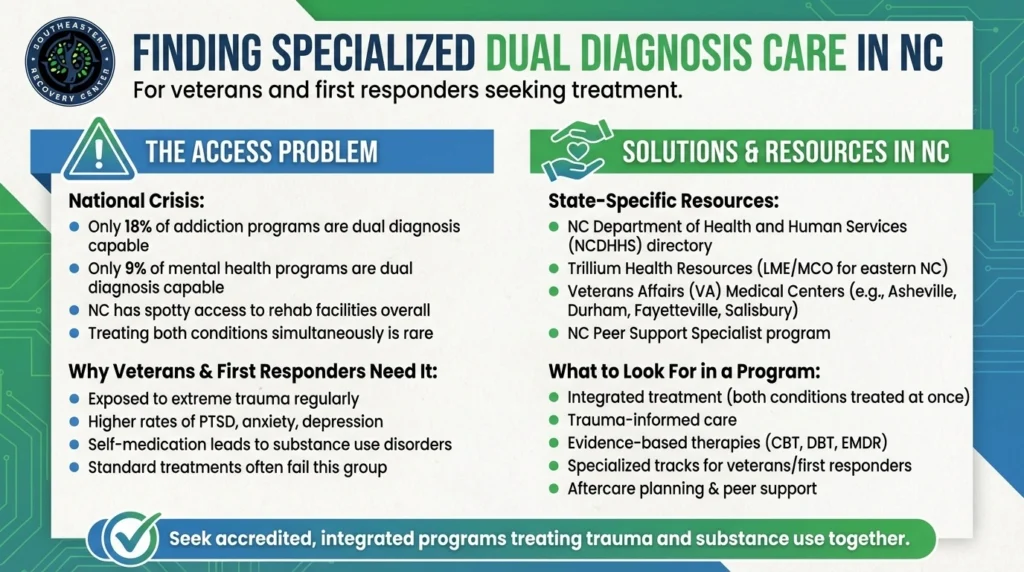
Additionally, a study of mental health and addiction treatment services across the United States found that only 18% of addiction treatment and 9% of mental health programs meet the criteria for dual diagnosis capable services.
Access to dual diagnosis treatment is a problem not just in North Carolina, but across the United States. At Southeastern Recovery Center, we are doing our part to provide personalized dual diagnosis care to veterans and first responders, but improved access to mental health services helps everyone in the community, not just those who most immediately need it.
What Types of Mental Health Disorders Occur Simultaneously as Substance Use Disorders?
There are a wide range of mental health disorders that may co-occur at the same time as substance use disorders. These include:
- Anxiety
- Post-traumatic stress disorder (PTSD)
- Depression
- Schizophrenia
- Personality disorder
Even at facilities that provide first responder addiction treatment in Charlotte, not every center that provides dual diagnosis treatment will have the qualifications required to treat each of these mental health disorders.
If you or a loved one are seeking dual diagnosis treatment or veterans rehab in NC, make sure to look into the capability of the facility you’re considering. At Southeastern Recovery Center, we’re more than prepared to help veterans and first responders tackle co-occurring disorders such as substance use disorder paired with anxiety, depression, or PTSD.
Are There Any Addictive Substances That Are Known to Cause Mental Health Disorders?
While it is often mental health disorders that drive individuals to use drugs or alcohol, in some cases mental health disorders may be caused directly by substance abuse. For example, the Justice Department notes that MDMA (also known as ecstasy) causes deficits in serotonin function in the brain, which can lead directly to depression and anxiety. Additionally, drug abuse by adolescents during the formative years is not to disrupt cognitive development which can contribute to development of mental health disorders.
How Do I Know if I’m Going to Receive Specialized Dual Diagnosis Treatment?
The best way to better the first responders can ensure they receive specialized dual diagnosis care in North Carolina is to make sure that a prospective rehab facility is accredited and check that they tackle the specific mental health disorders and substance use disorders that they’re suffering from (such as opioid addiction or addiction to fentanyl). For example, we at Southeastern Recovery Center are accredited and more than capable of helping individuals searching for veterans rehab or alleviation for first responder addiction in Charlotte, North Carolina
FAQs about Veterans and First Responders: Specialized Dual Diagnosis Care in North Carolina
What is dual diagnosis?
Dual diagnosis is when an individual suffers from a mental health disorder simultaneously as a substance use disorder such as an addiction to drugs or alcohol.
How do care providers support dual diagnosis patients?
Care providers support dual diagnosis patients by treating both their mental health disorder and their substance use disorder, likely by tackling underlying causes that led to the development of their initial disorder.
What kind of mental health disorders happen at the same time as substance use disorders?
Mental health disorders that happen at the same time as substance use disorders include PTSD, depression, and anxiety.
What drugs can cause mental health disorders?
Ecstasy can cause mental health disorders such as depression and anxiety due to its impact on serotonin function.
Sources:
VAntagePoint Contributor. “For a Successful Recovery Treatment of Dual Diagnosis Is Paramount.” VA News, 16 Feb. 2018, news.va.gov/45281/for-a-successful-recovery-treatment-of-dual-diagnosis-is-paramount/.
Obuobi-Donkor, Gloria, et al. “A Scoping Review on the Prevalence and Determinants of Post-Traumatic Stress Disorder among Military Personnel and Firefighters: Implications for Public Policy and Practice.” International Journal of Environmental Research and Public Health, vol. 19, no. 3, 29 Jan. 2022, p. 1565, www.ncbi.nlm.nih.gov/pmc/articles/PMC8834704/, https://doi.org/10.3390/ijerph19031565.
SAMHSA. “Co-Occurring Disorders and Other Health Conditions.” Samhsa.gov, 2024, www.samhsa.gov/substance-use/treatment/co-occurring-disorders.
McGovern, Mark P., et al. “Dual Diagnosis Capability in Mental Health and Addiction Treatment Services: An Assessment of Programs across Multiple State Systems.” Administration and Policy in Mental Health and Mental Health Services Research, vol. 41, no. 2, 27 Nov. 2012, pp. 205–214, www.ncbi.nlm.nih.gov/pmc/articles/PMC3594447/, https://doi.org/10.1007/s10488-012-0449-1. Accessed 25 Apr. 2019.
McGovern, Mark P., et al. “Dual Diagnosis Capability in Mental Health and Addiction Treatment Services: An Assessment of Programs across Multiple State Systems.” Administration and Policy in Mental Health and Mental Health Services Research, vol. 41, no. 2, 27 Nov. 2012, pp. 205–214, www.ncbi.nlm.nih.gov/pmc/articles/PMC3594447/, https://doi.org/10.1007/s10488-012-0449-1. Accessed 25 Apr. 2019.
SAMHSA. “What Are Co-Occuring Disorders?” Samhsa.gov, 24 Apr. 2023, www.samhsa.gov/mental-health/what-is-mental-health/conditions/co-occurring-disorders.
National Drug Intelligence Center. “Drug Abuse and Mental Illness Fast Facts.” Www.justice.gov, Apr. 2004, www.justice.gov/archive/ndic/pubs7/7343/index.htm.