Today’s rapidly advancing world has re-shaped the way healing and addiction treatment are administered. The shift into a more virtual alcohol or drug rehab setting gives hope to people throughout the North Carolina region who were functional addicts or functional alcoholics, but could not find a way to make treatment work while maintaining their lives.
If you’ve ever felt stuck between wanting to heal and managing the daily responsibilities that keep you going, you’re not alone. The truth is, recovery shouldn’t require you to put your entire life on pause. That’s exactly why Virtual Intensive Outpatient Programs (IOP) have become such a meaningful option for people across our state.

TL;DR: Quick Overview
Virtual Intensive Outpatient Programs (IOP) are changing recovery in North Carolina by making treatment accessible, flexible, and effective.
Key Benefits:
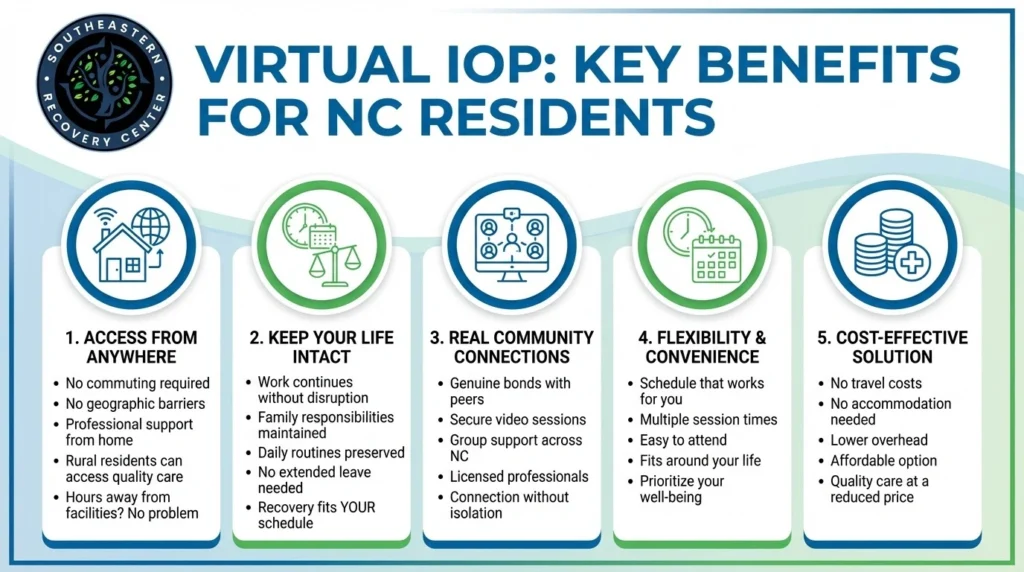
- Access care from anywhere – No commuting, no location barriers, just professional support from home
- Keep your daily life intact – Work, family, and responsibilities don’t have to stop while you heal.
- Real community connections – Form genuine bonds with peers and therapists through secure video sessions
- Comprehensive treatment – Address addiction and mental health together with specialized support for your unique situation
- Privacy you deserve – Seek help discreetly without worrying about being seen at a facility.
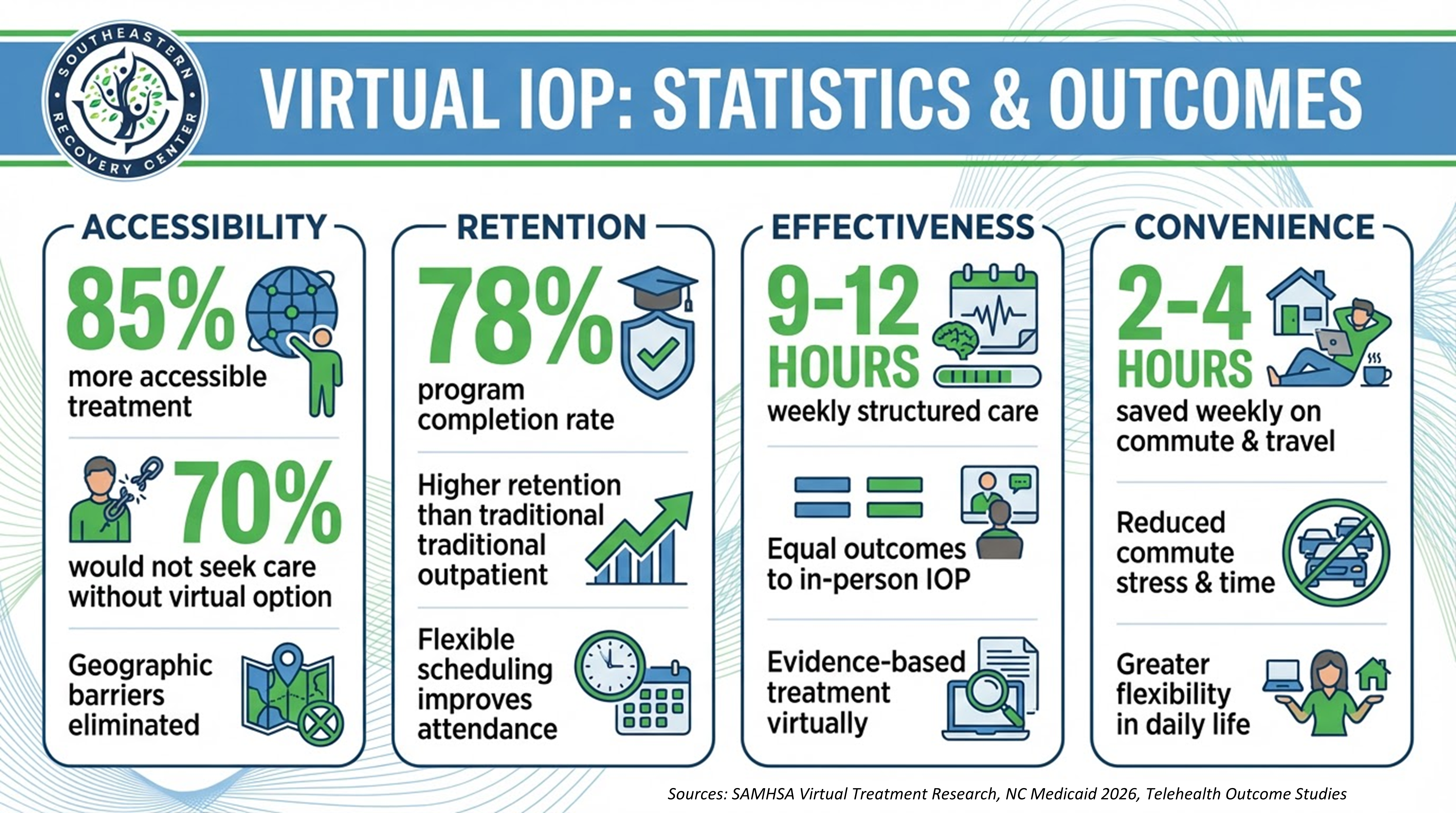
What You Get: 9-12 hours weekly of group therapy, individual counseling, skills training, and education – all delivered virtually by licensed professionals who care about your success.
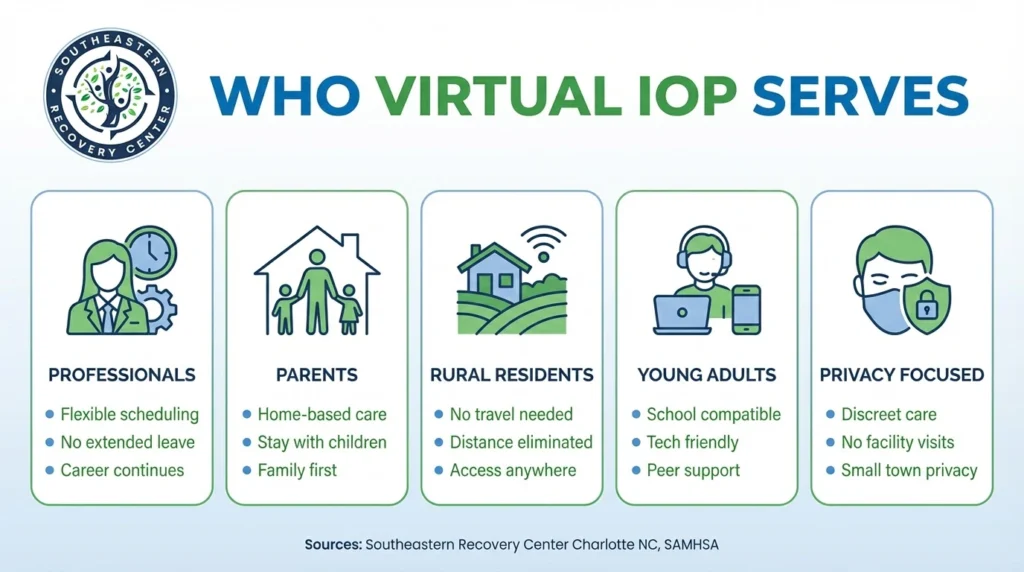
Who It’s For: Busy professionals, parents, young adults, rural residents, or anyone who needs quality treatment that adapts to their life instead of requiring them to abandon it.
The Bottom Line: Recovery in 2026 doesn’t mean putting your life on hold. Virtual IOP meets you where you are and helps you build the life you deserve. That first step is easier than you think – and you don’t have to take it alone.
For too long, the image of recovery meant checking into a facility, leaving your job, arranging care for your children, and stepping away from all that is familiar. While that level of care is absolutely necessary and life-saving for many people, it’s not the only way forward. And for those who have responsibilities they simply cannot set aside, or who have tried to seek help before but found the logistics impossible, virtual care offers something different. It offers a possibility.
When Life Doesn’t Stop, Your Healing Shouldn’t Have To
We all know how demanding life can be. Between work commitments, caring for family, and simply keeping up with daily responsibilities, finding time to focus on your own well-being can feel impossible. And for many people, the challenges that come with traditional treatment (like long commutes, time away from home, or arranging childcare) can feel overwhelming before you even begin.
Maybe you’re a single parent who can’t imagine being away from your children for weeks at a time. Maybe you’re in a career where taking an extended leave would put your livelihood at risk. Maybe you live in a rural area where the nearest treatment center is hours away, and you don’t have reliable transportation. Maybe you’ve been carrying shame about your struggles, and the thought of walking through the doors of a treatment facility in your community feels like too much exposure.
These aren’t excuses. These are real barriers that have kept too many people from getting the help they need and deserve. Virtual care reaches you right where you are. It recognizes that you have a life that matters and responsibilities that can’t just disappear. Here’s what makes it different:
You Can Access Help From Anywhere
Whether you’re in Charlotte, the mountains, or a small town hours from the nearest treatment center, professional support is available to you. Geography no longer determines your access to quality care. If you’ve completed medical detox and need consistent follow-up care, virtual IOP allows you to continue your progress without the additional stress of travel. For people exploring outpatient options, this flexibility can make all the difference between starting treatment and putting it off another day, another week, another year.
The technology is simple. You don’t require anything fancy. A smartphone, tablet, or computer with internet access is all it takes to connect with licensed therapists, counselors, and peers who understand what you’re going through. Sessions take place on secure, HIPAA-compliant video platforms that protect your privacy while providing face-to-face interaction with your treatment team.
Your Home Becomes Part of Your Healing
There’s something powerful about mastering how to navigate triggers and challenges in the actual environment where you live. When you work through difficult moments with your therapist and then immediately practice those skills in your own space, the lessons stick. This is real-world recovery that translates directly into your daily life.
Think about it: when you complete a session about managing stress or handling cravings, you don’t have to wait until you get home to try out those new skills. You’re already there. You can identify the specific situations in your home, neighborhood, and daily routine that feel most challenging, and work on them in real time with professional support. This isn’t theoretical recovery. This is practical, lived-experience healing that happens in the context of your actual life.
Your Privacy Matters
For many professionals and parents, the thought of being seen walking into a treatment facility feels vulnerable. Virtual care gives a level of privacy that helps people take that first step without additional worry. Whether you’re looking into specialized care for working professionals or simply want discretion, you deserve to seek help on your own terms.
There’s no parking lot to navigate, no waiting room where you might run into someone you know, no explaining to your boss why you need to leave work early three times a week. You can log in from your home office, your bedroom, or anywhere you feel safe and comfortable. For people in small communities where everyone knows everyone, this privacy can be the difference between seeking help and suffering in silence.
You’re Not Alone in This
One concern people sometimes have about virtual treatment is whether they’ll feel connected to others. Will it feel isolating? Will they miss out on the community side of recovery? Will staring at a screen really create the kind of bonds that help people heal?
What we’ve learned is quite the opposite. People participating in virtual group sessions often express feeling more comfortable opening up from their own homes. Whether someone is engaging in men’s focused recovery programs or women’s specialized treatment, there’s something about being in a familiar, safe space that enables deeper honesty. The connections developed in these digital spaces are genuine, supportive, and lasting.
In many ways, the virtual method actually removes some of the social anxieties that can make in-person group therapy intimidating. People who might have felt self-conscious about their appearance, their clothes, or how others perceive them in a physical space often find it easier to focus on what really matters: the content of the conversation, the common experiences, and the mutual support.
Recovery has always been about the “we,” not just the “me.” Virtual platforms have simply expanded who can be part of that “we.” You might find yourself in a group with people from across the state, bringing different perspectives and experiences, all bound by the common goal of recovery and development. These connections frequently go beyond scheduled sessions, with many programs offering online peer support groups, alumni networks, and digital communities where people can check in, celebrate victories, and support each other through difficulties.
The power of hearing someone else say, “I understand exactly what you’re going through,” doesn’t diminish because it happens through a screen. The accessibility of virtual connection meanssupport is available more readily. Having a hard day? Your recovery community is only a click away.
Discovering What Works for Your Unique Situation
Everyone’s path to wellness looks a little different, and that’s okay. While some people need the round-the-clock support of residential treatment facilities, many others find that a virtual or hybrid approach provides the structure they need while helping them maintain their daily lives.
The beauty of today’s treatment landscape is that it’s not one-size-fits-all. You might start with inpatient care to get stabilized, then shift to virtual IOP as you begin to rebuild your life. Or you might find that virtual IOP is the right level of care from the start, offering the intensity and structure of a comprehensive program without requiring you to step away from your responsibilities.
At Southeastern Recovery Center, we’ve watched numerous individuals rediscover themselves through our Virtual IOP program. The flexibility it offers doesn’t mean less intensive care. It means care that adapts to you rather than requiring you to adapt everything else in your life. When you’re researching PHP and IOP programs in Charlotte, consider how virtual treatment might support your specific circumstances.
Virtual IOP ordinarily involves 9 to 12 hours of programming per week, spread across multiple days. This might include individual therapy sessions where you work one-on-one with a counselor, group therapy where you communicate with peers dealing with similar challenges, psychoeducation classes that teach you about addiction and recovery, skills training that gives you practical tools for managing cravings and stress, and family sessions that help repair and strengthen your relationships.
The schedule is built to be rigorous enough to create real change while flexible enough to work around your life. Morning sessions for night shift workers. Evening sessions for people with traditional day jobs. Weekend options for those with weekday commitments. The goal is to remove every possible barrier between you and the help you need.
For people seeking a higher level of comfort and amenities during their recovery journey, luxury treatment options now include virtual help that brings premium care directly to you. This might mean access to additional services, such as nutrition counseling, fitness coaching, mindfulness instruction, and concierge-level care coordination, all delivered virtually to complement your core treatment program.
Treating the Whole Person, Not Just the Symptoms
True healing addresses more than just substance use. It looks at the underlying reasons, the mental wellness challenges, the trauma, and the life circumstances that contributed to where you are today. That’s why comprehensive dual diagnosis care addresses both mental health and addiction together.
So often, addiction doesn’t exist in isolation. It’s associated with depression, anxiety, PTSD, bipolar disorder, or other mental health conditions. Treating one without addressing the other is like attempting to heal a wound while ignoring the infection. It doesn’t work. Effective treatment considers the whole picture and creates a plan that addresses all your needs simultaneously.
Whether you’re struggling with challenges with opioids, alcohol, prescription medications, or other substances, the goal is still the same: helping you build a life that feels worth living. For individuals looking for help with opioid dependency, alcohol recovery, cocaine addiction, or prescription medication issues, specialized support is available that understands your special challenges.
Each substance comes with its own patterns, risks, and recovery considerations. The person struggling with alcohol faces different challenges than someone dependent on opioids. Someone who started with a legitimate prescription for pain medication needs different support than someone who turned to stimulants to keep up with work demands. Quality treatment recognizes these differences and tailors the approach accordingly.
Treatment rooted in trauma-informed approaches assures that your past experiences are honored and that your healing happens at a pace that feels safe for you. When you’re exploring mental health and addiction treatment in Charlotte, look for programs that see you as a whole person, not just a diagnosis.
Trauma-informed care means that your treatment team understands how past experiences affect present behaviors. It means building an environment where you feel safe enough to explore difficult memories and emotions. It means never forcing you to share more than you’re ready, while softly encouraging growth at your own pace. This approach recognizes that healing isn’t linear. There will be good days and hard days, steps forward and moments when you feel stuck. All of that is part of the process, and it all deserves compassion.
New Support Makes Recovery More Accessible
There’s encouraging news for North Carolinians seeking treatment. As of January 2026, new policies ensure that people can maintain their nutrition assistance benefits while actively involved in recovery programs. This removes a significant worry for families, allowing them to focus entirely on healing without fear of losing essential support.
This policy change recognizes what should have been obvious all along: people shouldn’t have to choose between getting treatment and feeding their families. Recovery requires enormous energy, focus, and commitment. Worrying about whether you’ll be able to put food on the table makes that journey infinitely harder. These new protections mean that taking care of your health won’t put your family’s basic needs at risk.
Additionally, Medicaid expansion continues to make treatment more accessible for thousands of people across the state. Combined with resources like supportive sober living environments that provide community support after initial treatment, there are more pathways to recovery than ever before.
The financial aspect of treatment can feel overwhelming, but there are more options available than many people realize. Between insurance coverage, Medicaid, sliding-scale fees, and payment plans, most people can afford quality care. And increasingly, the question isn’t whether you can afford treatment, but whether you can afford not to seek it. The cost of untreated addiction, both financial and personal, far exceeds the investment in recovery.
For those who have completed their primary treatment, structured aftercare programs help maintain the progress you’ve worked so hard to achieve. Connecting with local recovery resources can provide ongoing support as you build your new life.
Recovery doesn’t end when your formal treatment program does. In fact, that’s when the real work often begins. Aftercare provides the ongoing support, accountability, and connection that help prevent relapse and sustain enduring wellness. This might include continued individual therapy, alumni groups, 12-step meetings, SMART Recovery groups, or other community resources. The key is keeping connected and not trying to do this alone.
Understanding What Virtual IOP Really Looks Like
If you’re new to the idea of virtual treatment, you might be wondering what it actually looks like in practice. How do sessions work? What happens if you have a technical issue? What if you need help between scheduled sessions?
A typical week in virtual IOP might include three to four group therapy sessions, one or two individual counseling sessions, and learning workshops on topics such as relapse prevention, stress management, healthy communication, and life skills. Each session is facilitated by licensed professionals who create a structured, helpful environment where healing can happen.
Group sessions usually involve six to ten participants, all at similar stages in their healing process. Your therapist guides the conversation, assuring everyone has a chance to share, introducing topics and exercises, and fostering a safe space for vulnerability and growth. You’ll learn from others’ experiences, offer support based on what you’ve learned, and build relationships that often stay crucial to your recovery.
Individual sessions give you dedicated time with a counselor to work on your unique challenges, process difficult emotions, set personal goals, and develop strategies tailored to your situation. This is your time to focus entirely on yourself without worrying about group dynamics or others’ needs.
The educational components teach you the science behind addiction, helping you understand why your brain responds the way it does and how to work with that knowledge rather than against it. You’ll learn practical skills for managing triggers, handling stress without substances, communicating your needs effectively, and building a life that supports your recovery.
Between sessions, many programs offer additional support through peer support apps, 24/7 crisis lines, text check-ins with your care team, and online resources you can access whenever you need them. Recovery doesn’t happen only during scheduled appointments. It’s a daily commitment, and your treatment team stays available to support you throughout the process.
Your Next Step Is Waiting
If you’ve been thinking about getting help but haven’t known where to start, please know that there are options that work with your life, not against it. Whether you’re a young adult just beginning this journey, a professional balancing a demanding career, or a parent trying to show up fully for your family, there are programs developed with your specific needs in mind.
When searching for addiction treatment in Charlotte, NC, you’ll find that today’s options are more flexible and compassionate than ever before. Finding alcohol recovery support for you or a loved one, or looking into comprehensive drug rehab programs doesn’t have to mean disrupting your entire world.
Recovery doesn’t require you to abandon your responsibilities or disappear from your life. It simply asks you to be willing to try. To be honest about where you are. To accept that you deserve support. To take that first small step, even when you’re not sure where it will lead.
The way forward might look different than you imagined. It might be gentler than you expected. It may fit into your life through ways you didn’t think possible. But it’s there, waiting for you to take that first step.
In 2026, that first step can happen right from where you’re sitting. You don’t have to have everything figured out. You don’t have to be “ready enough” or “bad enough” to deserve help. You don’t have to wait until you’ve lost everything to decide you’re worth saving. You just have to take one small step forward.
Reach out today. Ask questions. Explore your options. Talk to someone who understands. Your life is worth fighting for, and you don’t have to fight alone.
And we’re here to walk with you when you do.
Sources
American Psychiatric Association. “What Is a Substance Use Disorder?” Psychiatry.org, American Psychiatric Association, 2024, www.psychiatry.org/patients-families/addiction-substance-use-disorders/what-is-a-substance-use-disorder.
Center for Substance Abuse Treatment. “Intensive Outpatient Treatment for Alcohol and Other Drug Abuse.” Substance Abuse and Mental Health Services Administration, U.S. Department of Health and Human Services, Treatment Improvement Protocol (TIP) Series, No. 8, 2006, www.ncbi.nlm.nih.gov/books/NBK64093/.
Fiscella, Kevin, et al. “Effectiveness of Telemedicine for Substance Use Disorder Treatment.” JAMA Network Open, vol. 5, no. 2, Feb. 2022, doi:10.1001/jamanetworkopen.2021.41190.
Lin, Lewis A., et al. “Telemedicine-Delivered Treatment Interventions for Substance Use Disorders: A Systematic Review.” Journal of Substance Abuse Treatment, vol. 101, June 2019, pp. 38-49, doi:10.1016/j.jsat.2019.03.007.
National Institute on Drug Abuse. “Treatment and Recovery.” NIDA, National Institutes of Health, Dec. 2024, nida.nih.gov/publications/drugs-brains-behavior-science-addiction/treatment-recovery.
National Institute on Drug Abuse. “Words Matter: Preferred Language for Talking About Addiction.” NIDA, National Institutes of Health, Apr. 2024, nida.nih.gov/research-topics/addiction-science/words-matter-preferred-language-talking-about-addiction.
National Institute of Mental Health. “Substance Use and Co-Occurring Mental Disorders.” NIMH, National Institutes of Health, 2024, www.nimh.nih.gov/health/topics/substance-use-and-mental-health.
North Carolina Department of Health and Human Services. “NC Medicaid Expansion.” NCDHHS, State of North Carolina, 2025, www.ncdhhs.gov/about/department-initiatives/healthy-opportunities/medicaid-expansion.
Substance Abuse and Mental Health Services Administration. “Key Substance Use and Mental Health Indicators in the United States: Results from the 2023 National Survey on Drug Use and Health.” SAMHSA, U.S. Department of Health and Human Services, Publication No. PEP24-07-021, 2024.
Substance Abuse and Mental Health Services Administration. “Telehealth for the Treatment of Serious Mental Illness and Substance Use Disorders.” SAMHSA, U.S. Department of Health and Human Services, Publication No. PEP21-06-02-001, 2021, store.samhsa.gov/product/telehealth-treatment-serious-mental-illness-substance-use-disorders/PEP21-06-02-001.
Uscher-Pines, Lori, et al. “Virtual First Response to COVID-19: Lessons for Telehealth in Addiction Treatment.” Health Affairs, vol. 40, no. 6, June 2021, pp. 916-924, doi:10.1377/hlthaff.2020.02374.
Weintraub, Eran, et al. “Effectiveness of Intensive Outpatient Treatment for Substance Use Disorders.” Journal of Substance Abuse Treatment, vol. 48, no. 1, Jan. 2015, pp. 1-8, doi:10.1016/j.jsat.2014.07.018.